




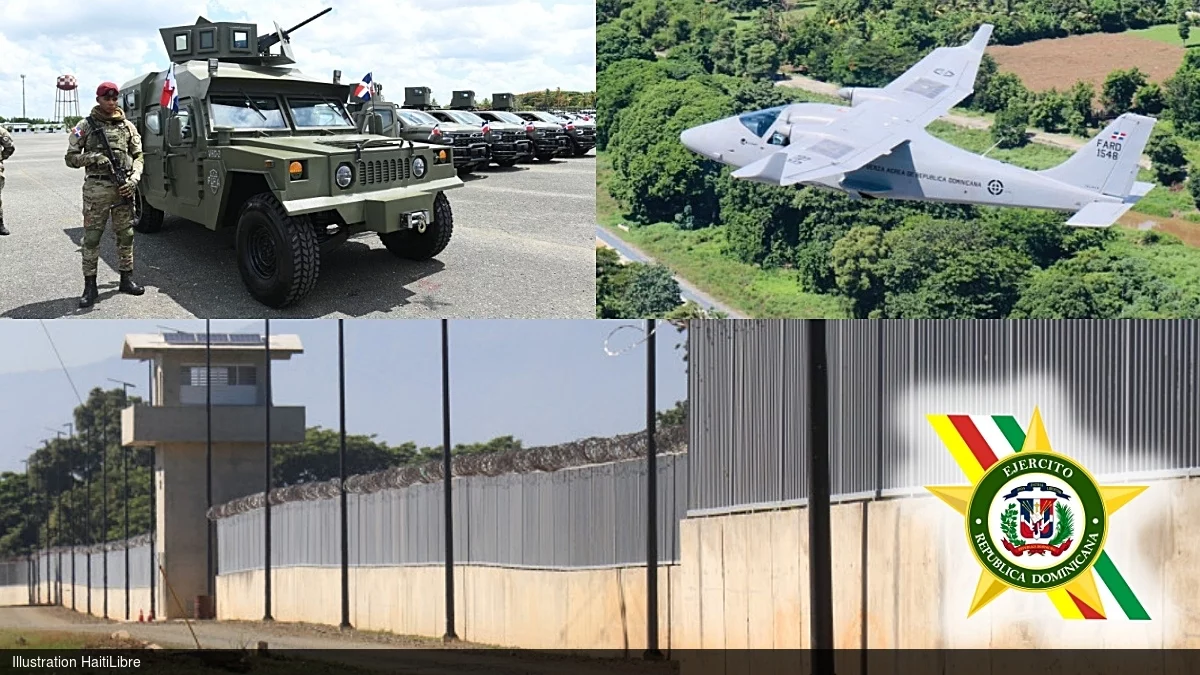
The Dominican military industry is experiencing significant growth, driven by initiatives aimed at enhancing border control and national security along its border with Haiti. The nearly 391-kilometer border, which consists of diverse terrain, including rivers and roads, presents unique challenges for surveillance and security efforts.
Border Security Initiatives Underway
The Dominican government has commenced the construction of a perimeter fence, featuring reinforced concrete barriers and patrol lanes that facilitate the rapid deployment of security forces. This perimeter is intended to fortify the most vulnerable sections of the border, which benefits from four official crossing points: Dajabón, Elías Piña, Jimaní, and Pedernales. These crossings are pivotal for trade and binational economic activities.
Lieutenant General Carlos Antonio Fernández Onofre, the Minister of Defense, elaborated on the project’s sophistication, which includes the deployment of watchtowers, technological equipment, and a fiber optic network designed for real-time communication of voice and images. Fernández Onofre noted that these advancements have markedly improved security, particularly in areas historically affected by theft.
The Dominican military has also developed the TP-75 DULUS, the first aircraft specifically constructed for surveillance and reconnaissance tasks. The aircraft is expected to enhance operational coordination between air and ground forces while offering intelligence support crucial for maintaining order along the border. Fernández Onofre emphasized the aircraft’s low operational costs, stating it can effectively patrol the border within four hours for a minimal fuel expense.
In addition to land-based measures, the Dominican Navy has expanded its maritime control capabilities to secure both northern and southern maritime borders adjacent to Haiti. These efforts are aimed at combating illegal activities, including smuggling and human trafficking, while also ensuring the safety of lives at sea. The Minister indicated that patrol efforts will continue to increase as new vessels are integrated into the Navy’s fleet.
This year, an agreement between the Dominican Republic and Portugal for the acquisition of four offshore patrol vessels is also set to enhance naval efficiency in maintaining territorial integrity in both national and international waters.
The developments in the Dominican military industry not only reflect a prioritization of border security but also mark progress in the country’s defense capabilities during a time of regional instability.
Why It Matters
The strengthening of the Dominican military and border security initiatives is particularly significant given the geopolitical context of the region. Such measures aim to stabilize the border area, enhance trade security, and address illicit activity, thereby promoting overall safety and economic vitality in both the Dominican Republic and Haiti.
