




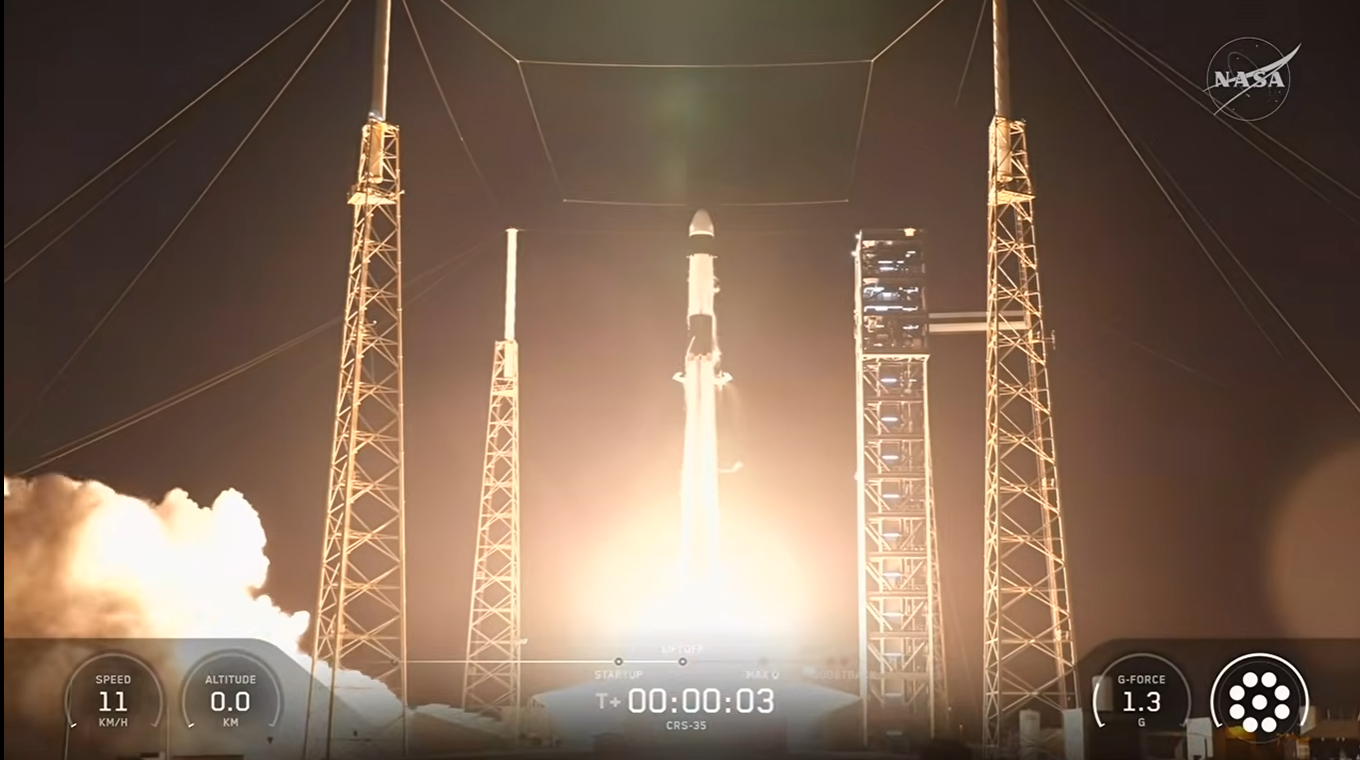
NASA’s SpaceX 35th commercial resupply mission successfully launched at 6:33 a.m. EDT on Tuesday from Cape Canaveral Space Force Station in Florida. The Falcon 9 rocket carried over 6,300 pounds of supplies and hardware to the International Space Station (ISS).
The SpaceX Dragon spacecraft is scheduled to autonomously dock with the ISS at 11 a.m. on Thursday, October 15. NASA will provide live coverage of the docking on various platforms starting at 9:15 a.m. Viewers can access the stream at www.nasa.gov/live.
This mission includes the final pair of Roll-Out Solar Arrays, which will enhance the ISS’s power system, ensuring additional electricity for research and safe operations. Astronauts will install these arrays during planned spacewalks later this fall.
In addition to the solar arrays, the Dragon spacecraft is delivering several important scientific experiments. Among these are hardware designed to manufacture artificial retinas in microgravity, which could benefit patients with vision impairment on Earth, and 3D heart tissue models aimed at improving drug testing processes for future space missions. The spacecraft also carries materials to study a new type of glass formation in microgravity and brain organoids that may help identify treatment targets for neurodegenerative diseases, including Alzheimer’s and Parkinson’s.
This resupply mission supports hundreds of ongoing investigations aboard the ISS, spanning areas such as biology, biotechnology, physical sciences, and Earth and space sciences. Such research contributes to advances that benefit life on Earth and prepare for future deep space missions, including NASA’s Artemis program, which aims to send astronauts back to the Moon as a precursor to human exploration of Mars.
The Dragon spacecraft is expected to remain at the ISS until mid-November, at which point it will return to Earth, splashing down off the California coast with valuable research and cargo.
For more information on the ISS and its research initiatives, visit www.nasa.gov/station.
