




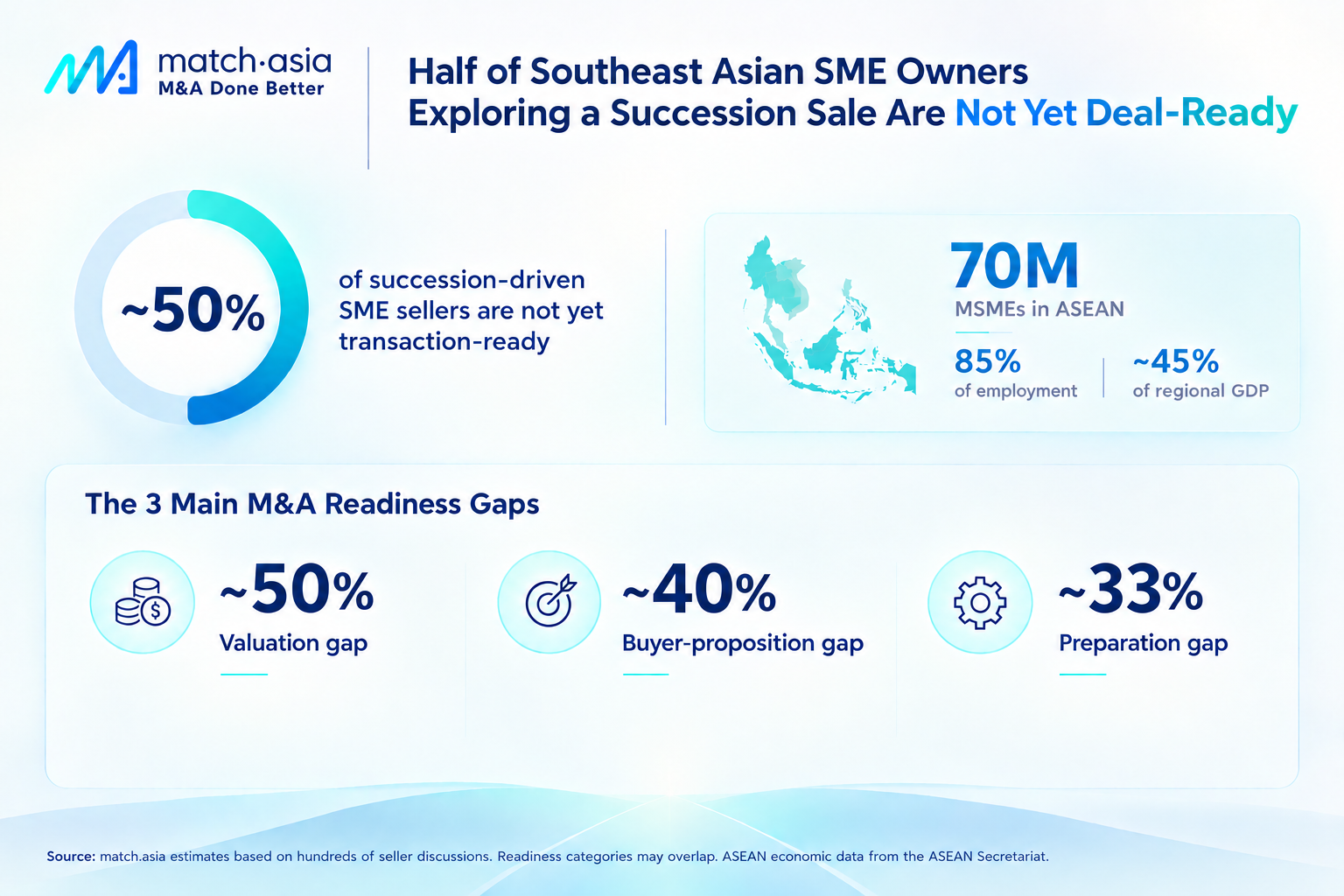
Nearly half of Southeast Asian small and medium-sized enterprise (SME) sellers exploring succession options are not yet prepared for a sale, according to estimates from match.asia, an AI-driven mergers and acquisitions platform. The findings, based on extensive discussions with SME owners across Singapore, Malaysia, Indonesia, Vietnam, Thailand, and the Philippines, highlight significant barriers to readiness in succession planning.
match.asia identified three primary issues affecting sellers who are assessed as unprepared for transactions: unrealistic valuation expectations, unclear buyer propositions, and inadequate operational readiness. These factors often overlap, indicating that business owners must address multiple issues simultaneously to enhance their chances of a successful sale.
As the urgency for succession planning grows, estimates suggest that about 30% of SME founders plan to step back within the next five to ten years; however, 60% of this group has not defined a succession path. In addition, among sellers actively seeking a succession solution, approximately half are considering external transactions.
“A founder may look for a successor long before the business is ready to stand on its own,” said Marcus Yeung, CEO and Co-Founder of match.asia. “That is the real succession gap. The company must be able to perform without depending on the person who built it.”
The analysis outlines three gaps contributing to the lack of transaction readiness:
- Valuation gap (50%): Sellers often have expectations that are unrealistic or not supported by the company’s financial performance and market conditions.
- Buyer-proposition gap (40%): The business may not offer a compelling reason for buyers to invest, reflecting issues like weak market positioning or limited growth.
- Preparation gap (33%): Insufficient management depth, poor financial reporting, and lacking operational systems can hinder buyer assessments and due diligence efforts.
Sellers looking for a change in ownership may have various motivations, including a lack of suitable successors, the desire for a reputable buyer to maintain company legacy, or the need for a strategic partner to drive growth.
Potential buyers typically require assurance of sustainable profitability and a clear trajectory for growth. Yeung noted that “sellers naturally value what they have built. Buyers pay for what the business can deliver in the future,” pointing out a common disconnect that can stall transactions.
In response to these challenges, match.asia conducts exit-planning workshops for SME owners and offers free valuation and exit-readiness tools. The team emphasizes preparing sellers and aligning their expectations with potential buyers before initiating the sales process.
The estimates from match.asia are based on real-world discussions with SME stakeholders and are intended to provide directional insights into the current landscape for business succession in the region.
