




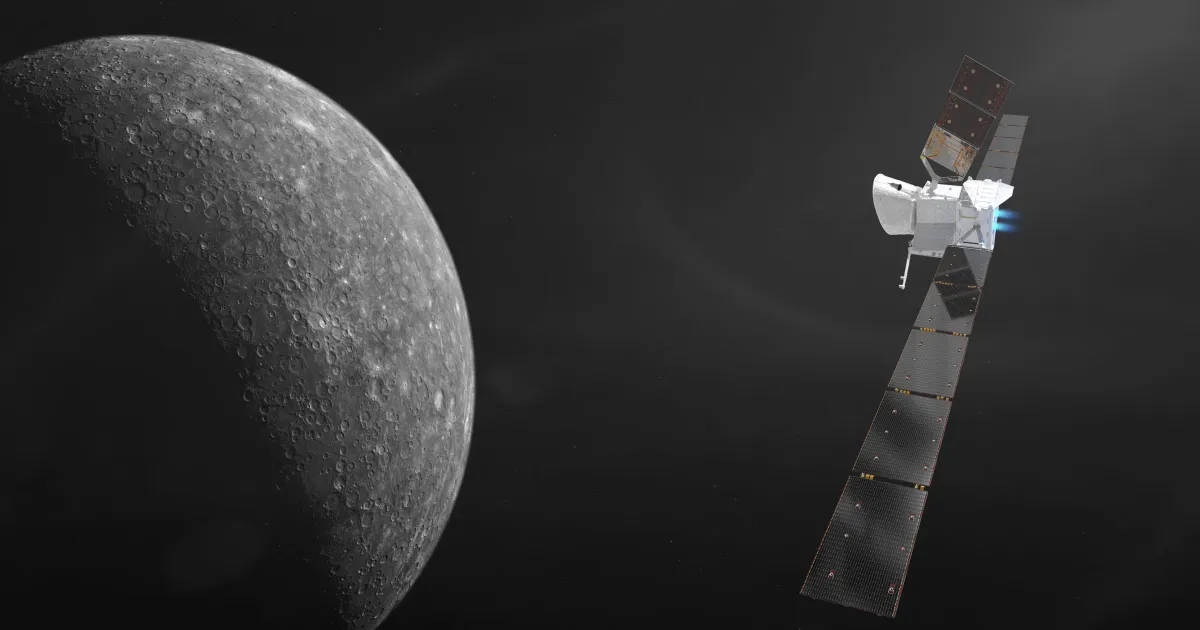
After an extensive eight-year journey covering nearly 6.2 billion miles, the BepiColombo spacecraft has successfully entered orbit around Mercury. The European Space Agency (ESA) and Japan Aerospace Exploration Agency (JAXA) confirmed the orbital insertion on November 21, marking the first return of a spacecraft to Mercury’s orbit since NASA’s MESSENGER mission concluded in 2015.
“We’ve heard back from Bepi – the spacecraft is now in contact with Ground and the teams at ESOC are busy assessing the telemetry, but Flight Dynamics already has confirmed it achieved orbital capture around Mercury!”
Currently, BepiColombo’s two science spacecraft are navigating together, and they face several months of complex maneuvers before commencing their main scientific investigations.
Two spacecraft, two different missions
BepiColombo comprises two distinct spacecraft built for studying different aspects of Mercury. The Mercury Planetary Orbiter (MPO), developed by ESA, will primarily focus on mapping the surface, analyzing its composition, and investigating its interior, particularly its unusually large iron core. Meanwhile, JAXA’s Mercury Magnetospheric Orbiter, known as Mio, is tasked with examining Mercury’s magnetic field and the encompassing magnetosphere.
The collaborative effort of these two spacecraft aims to provide a comprehensive understanding of Mercury by enabling simultaneous measurements from diverse locations. This mission seeks to clarify several long-standing questions, including:
- Why does Mercury possess a magnetic field despite its small size, which should have allowed its interior to cool significantly?
- What are the specific compositions of its surface and interior?
- How did the planet develop its substantial iron core?
Additionally, BepiColombo will explore permanently shadowed craters near Mercury’s poles that contain water ice, seeking to understand how ice can persist in such a thermally extreme environment.
An eight-year journey to the innermost planet
BepiColombo was launched on October 20, 2018, using an Ariane 5 rocket from Europe’s spaceport in French Guiana. While getting into orbit may seem straightforward, the journey to Mercury involved overcoming significant challenges. The Sun’s gravitational pull accelerates spacecraft moving inward, complicating the process of slowing down enough to achieve orbit.
To navigate these challenges, BepiColombo utilized a series of fuel-efficient planetary flybys, completing nine maneuvers: one around Earth, two around Venus, and six around Mercury. This strategy was essential for conserving fuel, which is vital for scientific operations.
The spacecraft’s arrival was delayed by about a year due to issues with the Mercury Transfer Module, which required engineers to adjust its trajectory and arrival timeline. This module is expected to separate from BepiColombo on September 3, 2026, after successfully delivering the mission to Mercury.
Mercury orbit insertion is only the beginning
The next key milestone is set for December 9, when the two orbiters will separate. Mio will enter a polar orbit to study Mercury’s magnetic environment from a different perspective. On December 16, the European orbiter will conduct additional engine burns to refine its orbit, aiming for its final scientific position by March 10, 2027.
Once in their designated orbits, engineers will take several weeks to commission the instruments and verify their functionality, with the primary science phase anticipated to commence on April 6, 2027.
Building on MESSENGER’s discoveries
BepiColombo aims to enhance the findings of NASA’s MESSENGER mission, which orbited Mercury from March 2011 until April 2015. MESSENGER produced significant insights into the planet’s surface and magnetic field, confirmed the presence of water ice, and revealed more about its volcanic history. As BepiColombo employs advanced instruments and dual spacecraft, scientists anticipate gaining deeper understanding and making comparisons with prior MESSENGER data to identify changes on Mercury.
