




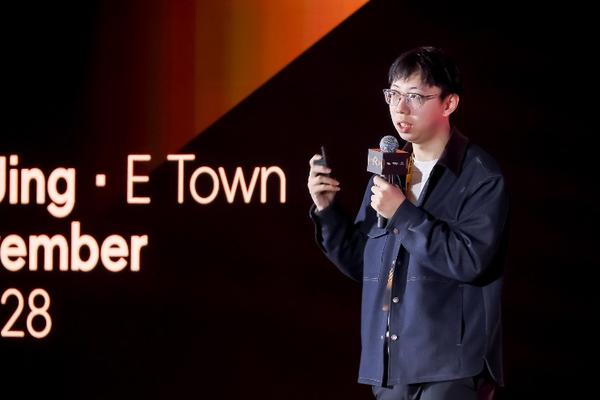
In a significant development for the business landscape, Chen Tianrun, the Founder and CEO of Moxin Technology, presented a compelling vision of artificial intelligence’s future during his keynote speech at the WISE2026 Business King Conference in Yizhuang, Beijing. The conference, hosted by 36Kr from November 26 to 28, 2026, marks a shift in focus from evaluating trends to addressing concrete questions about business innovation and AI integration.
During his address, titled “When the World is Generated: The Next Entrance of AI,” Chen articulated his belief that AI is evolving from mere content creation and question-answering capabilities to a new role within real-world environments, such as factories, roads, homes, shopping malls, and cities. He emphasized that this transition signifies an opportunity for AI to add measurable value to everyday life.
Chen stated that the evolving world model serves as a fundamental framework for AI to engage with the real world. He explained that understanding this environment involves not just identifying objects, but also comprehending their locations, relationships, ongoing changes, and potential future developments. Such capabilities are essential for AI to successfully simulate and navigate real-world scenarios.
According to Chen, the AI era presents a marked departure from previous business models that focused on user acquisition and traffic generation. “In the AI era,” he said, “the value of an entrance will depend on whether AI can be integrated into actual business processes and consistently create value.” This shift requires a comprehensive approach that moves beyond traditional platforms to foster direct interactions between AI and physical environments.
The speech further detailed how AI systems need to comprehend a range of contextual factors and relationships in order to function effectively. Chen highlighted that world models can bridge this gap, enabling machines to respond to real-world conditions and varying interactions. “If large language models enhance text processing, world models aim to revolutionize human-machine interaction through spatial awareness,” he noted.
Chen elaborated on practical applications of world models in various sectors, including the autonomous driving industry. He pointed out that simulation training in a controlled digital environment is critical for ensuring safety in real-world operations. By enabling rigorous testing and scenario planning, these models can support better decision-making in manufacturing and other industrial sectors.
Beyond industrial applications, Chen highlighted innovations in creative fields, such as film and video game production, where world models facilitate quicker scene creation and enhance user engagement. He mentioned the launch of the MoXiaochong app, which allows users to create interactive digital representations of their pets, illustrating how these technologies are being tailored for consumer experiences.
Chen concluded his speech by underscoring the transformative potential of AI as it increasingly integrates into various production and service processes. He expressed confidence that the next significant advancement in AI may come from its capability to interact with the world, emphasizing that “the next entrance of AI may be the world itself.”
