




Research from Columbia University’s Lamont-Doherty Earth Observatory suggests that Earth’s carbon may have originated from ancient meteorites during the planet’s formative years. The findings indicate that significant amounts of this carbon could have become trapped in the Earth’s core and later resurfaced through volcanic activity.
Lead author Yves Moussallam, an associate professor at the observatory, explained that the study’s chemical analysis focused on volcanic rocks from Hawaii, revealing unusual carbon dioxide signatures. These chemical fingerprints imply that carbon from the Earth’s core may have migrated upward through the planet’s layers.
“We think that we found evidence of carbon from Earth’s core leaking into the core-mantle boundaries and traveling all the way to the surface,” Moussallam said. The research is detailed in the Proceedings of the National Academy of Sciences.
Investigation into Earth’s Inner Structure
To comprehend how carbon might escape from the core, researchers looked at Earth’s internal layers. The mantle lies beneath a thin outer crust, extending about 1,800 miles downward, beneath which is the outer core, a molten metal layer around 1,400 miles thick, encasing the solid inner core. Scientists believe the majority of Earth’s carbon is stored in the core, although direct sampling is currently impossible due to extreme depths.
However, volcanic activity presents an alternative method of investigation. Recent studies suggest that elements can escape from the outer core into the mantle and be transported to the surface by mantle plumes—large columns of hot rock that originate near the core-mantle boundary. As these plumes rise, they can melt partially and form magma, which may eventually erupt through volcanoes.
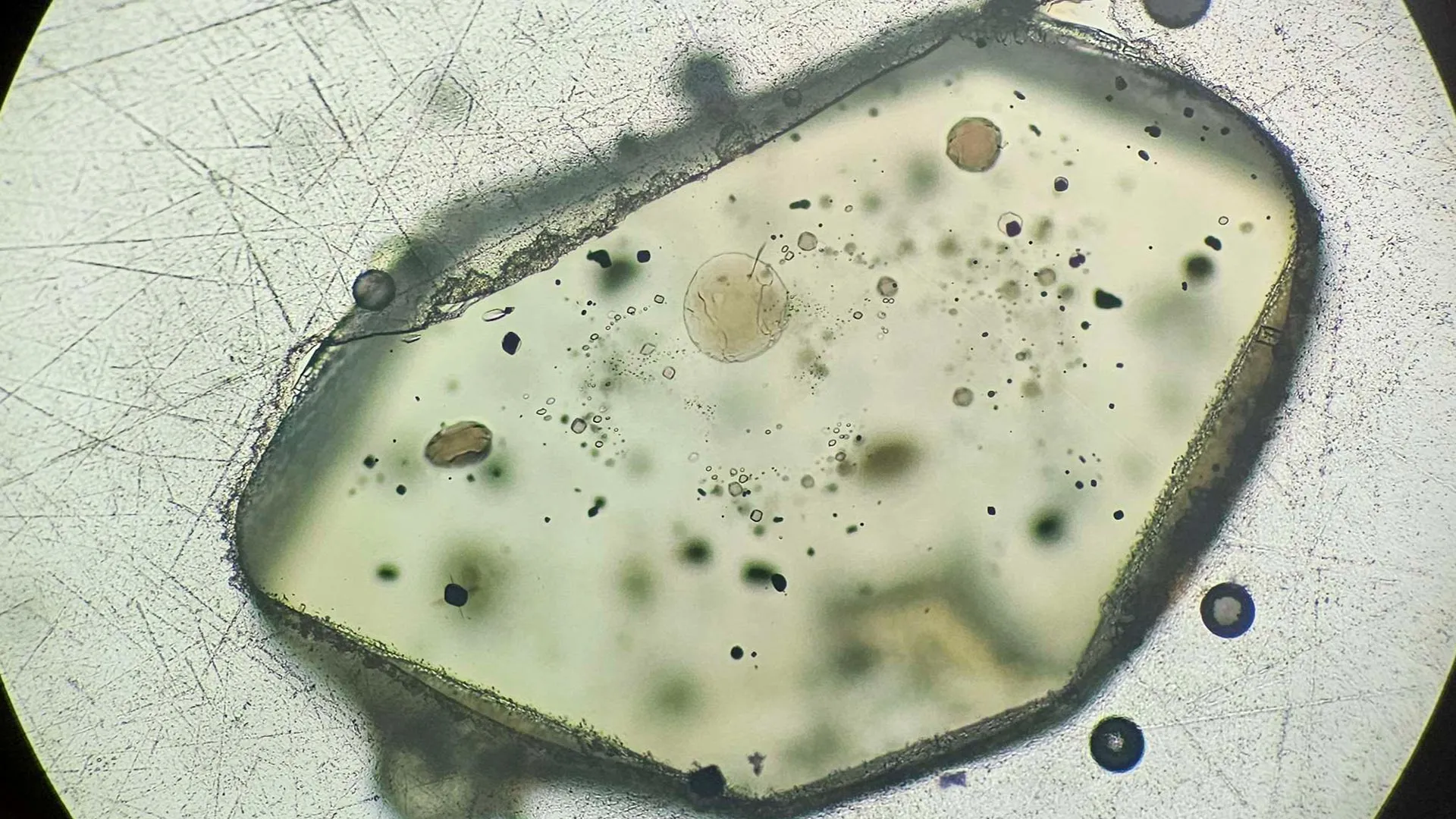
The study’s authors analyzed samples from the Kīlauea volcano and the Tantalus Rift. They utilized a new analytical technique to examine carbon isotopes preserved in undegassed melt inclusions, tiny pockets of magma. Such inclusions provide valuable information about the carbon’s origin, as they can trap gases before they escape.
While the isotopic signature of carbon from the Tantalus Rift matched expected measurements for mantle carbon, Kīlauea revealed a much heavier isotopic signature, suggesting a distinct source. “This means it must have been contaminated by another carbon source and that source is probably carbon from the core,” Moussallam noted.
Although the data leans toward the core being the source, researchers assert that further measurements are needed for confirmation.
The ancient carbon signature also aligns with isotopic compositions found in carbonaceous chondrites, a type of meteorite that dates back over 4.5 billion years. These meteorites are believed to be the building blocks of terrestrial planets. The researchers propose that these carbon-rich meteorites contributed to Earth’s carbon during its formation, as the young planet became capable of retaining such materials.
As a result, carbon essential for life on Earth may have traveled from the outer solar system, become embedded in the planet’s core, and finally resurfaced through volcanic eruptions over billions of years.
Despite the promising implications, significant questions persist regarding the exact sources of the carbon and the proportions attributed to different meteorite types. Moussallam emphasized the need for additional measurements, but acknowledged the study’s findings raise fascinating possibilities about the connection between solar system formation and the carbon integral to life on Earth.
The research was coauthored by a diverse team of scientists from Lamont-Doherty Earth Observatory, Yale University, and the US Geological Survey, among others.
