




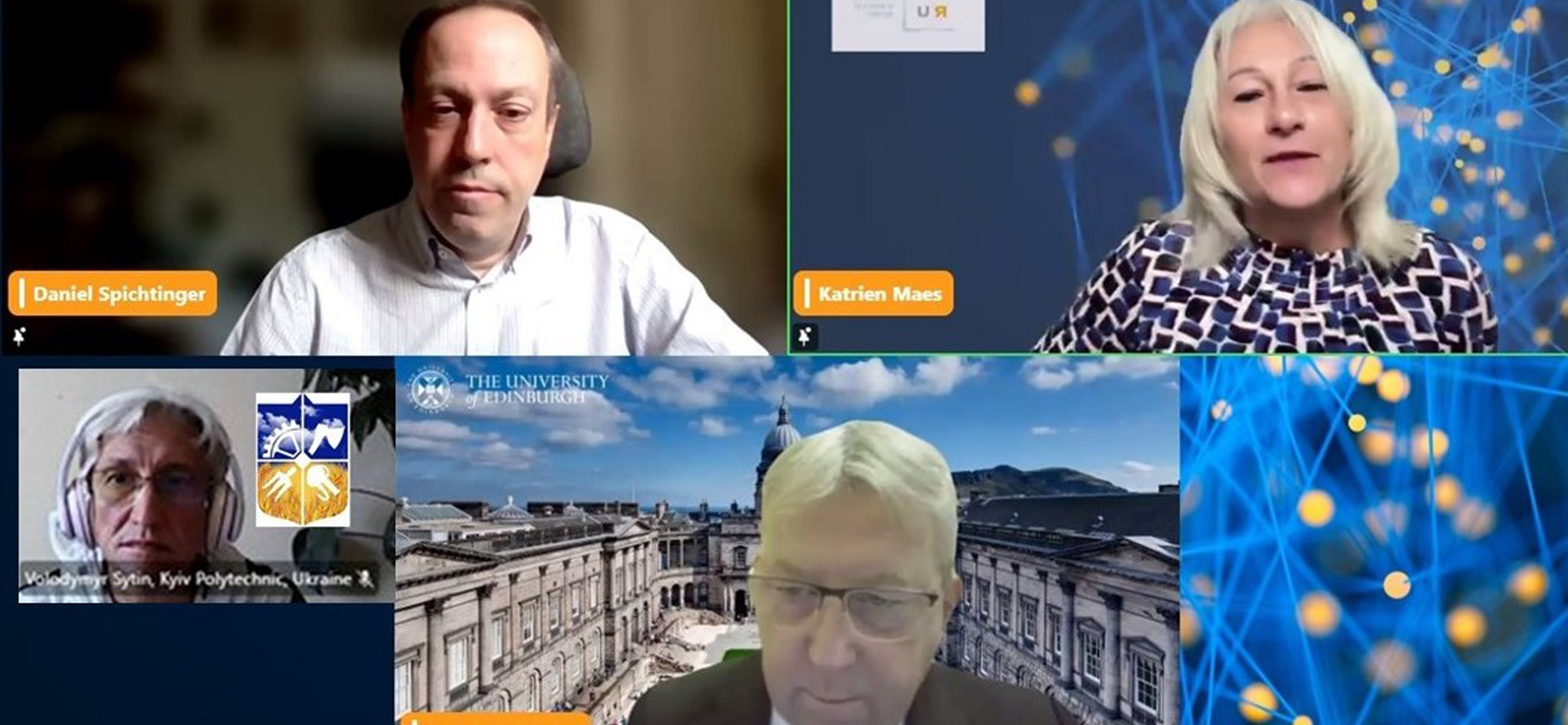
On November 23, 2026, a representative from the International Collaboration Department of the Igor Sikorsky Kyiv Polytechnic Institute (KPI) participated in a webinar hosted by the League of European Research Universities (LERU). The event focused on the theme “As open as possible, as secure as needed: How can universities navigate tensions between the open science and knowledge security agendas?”
This webinar is part of the LERU Talks series, which serves as an online platform for dialogue between universities and science policymakers, aiming to engage a broad audience.
Featured speakers included Sir Peter Mathieson, Principal and Vice-Chancellor of the University of Edinburgh, and Daniel Spichtinger, a European Research Policy Analyst and Open Science Expert. They discussed various topics, including:
- Whether the open science motto of being “as open as possible, as closed as necessary” is still feasible amid research security concerns.
- The necessary safeguards on knowledge security and the distinction between essential measures and bureaucratic overreach.
- The criteria for deciding what research should be open and what must remain closed.
- The possibility of aligning incentives for researchers with knowledge security guidelines similar to those for open science principles.
- Strategies for universities to maintain international connections while addressing legitimate research-security risks.
Dr. Katrien Maes, LERU Engagement Ambassador, welcomed around 200 online participants at the outset of the event. She initiated the discussion by posing the central question: Are open science and knowledge security fundamentally opposing concepts?
Mathieson emphasized the need for governments and funding bodies to strike a balance between openness and data security. He expressed concerns over cybersecurity and minimizing associated risks, noting that the focus often shifts to recovery strategies post-incident. “In principle, I think of researchers as risk-takers,” he stated. He also raised the issue of self-censorship as a growing barrier to academic freedom in universities worldwide.
Spichtinger asserted that open science should be the default mode of scientific research. He advocated for a bold approach in implementing the European Research Area (ERA) Act, linking open science to research assessment as a crucial step. Mathieson supported the idea of refining the assessment criteria for measuring success in research.
Addressing the risks of overly stringent regulations, Spichtinger remarked that while guidelines from the government are useful, it is primarily the responsibility of institutions and researchers to devise meaningful strategies.
In his conclusion, Mathieson highlighted the significance of developing a cultural understanding to balance risks and opportunities. Spichtinger suggested that future discussions could explore the relationship between open science and artificial intelligence, assessing whether AI represents a threat or an opportunity.
Kurt Deketelaere, LERU Secretary-General, underlined the importance of universities in actively engaging in this debate at both leadership and community levels. He emphasized that the responsibility for finding a balance between openness and security cannot be passed off to others.
Dr. Maes was recognized for her role in expertly moderating the discussion.
