




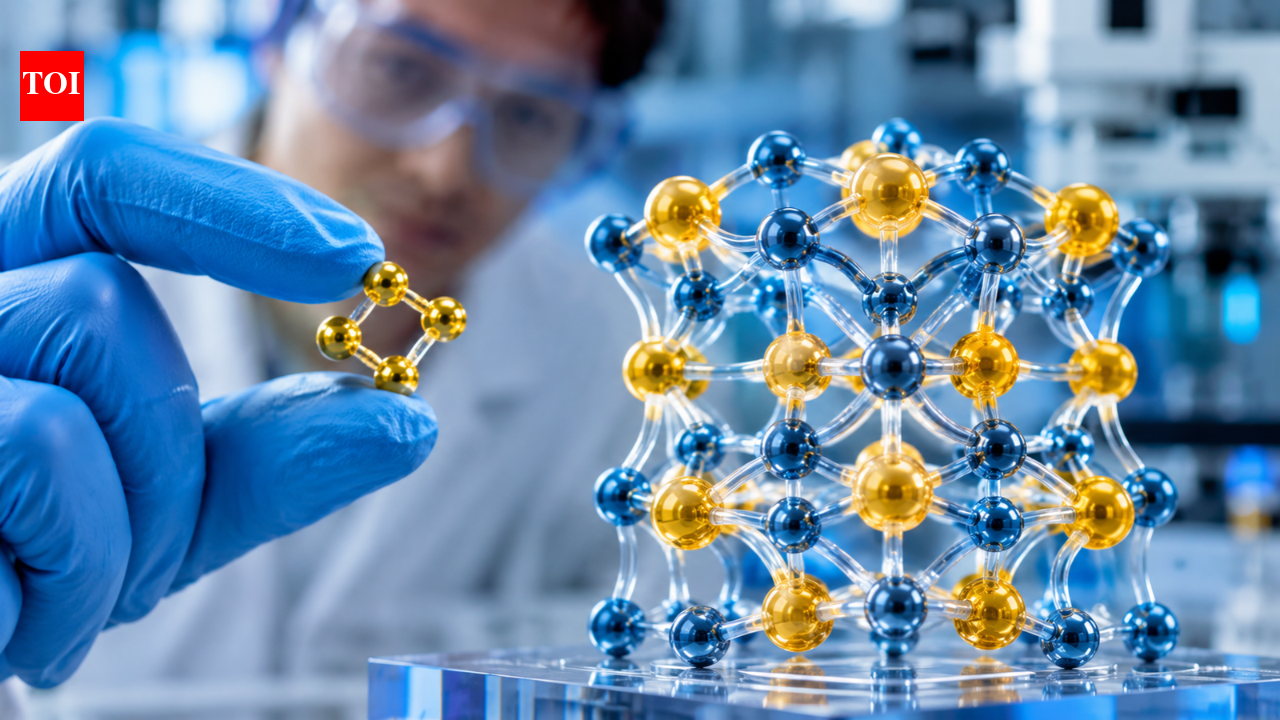
An MIT research team has challenged a longstanding principle in materials science by demonstrating that flexible molecular connections can effectively replace rigid ones in the assembly of nanoparticles. This breakthrough allows for the creation of new crystal structures that had not been previously observed.
For over 20 years, scientists have preferred rigid ligands to assemble gold nanoparticles, believing that their fixed shape would ensure stability in the final arrangement. However, the MIT team conducted experiments using polyethylene glycol (PEG)—a flexible polymer—to connect the nanoparticles. The research, published in the journal Nature, reveals that the adaptability of PEG allows for more dynamic arrangements and opens new avenues in the design of nanomaterials.
Transforming Nanoparticle Assembly
The arrangement of nanoparticles is crucial as it influences their behavior when forming materials, particularly in structured patterns known as superlattices. Traditionally, researchers employed rigid ligands to prevent particles from clustering together. To achieve specific arrangements, they used ligands that act as links between individual nanoparticles. The recent study showed that allowing for flexible connections instead can enhance the assembly process.
During the research, the MIT scientists modified the ends of the PEG chains to carry positive or negative electrical charges, promoting interactions between neighboring nanoparticles. This allowed the researchers to utilize the natural movement of the PEG chains during assembly instead of maintaining fixed connections, effectively letting the configuration evolve organically.
Rob Macfarlane, the lead materials scientist at MIT, noted that their approach diverged significantly from the established paradigm. Rather than enforcing precise connections before assembly, their method utilized the flexibility of the polymer to regulate the number of links forming between particles, shaping the final arrangement.
The team’s findings indicated that variations in both the sizes of the gold nanoparticles and the lengths of the connecting chains substantially influenced the arrangement of the resulting superlattices. Smaller nanoparticles resulted in fewer links, while longer chains allowed for greater flexibility and rearrangement during the assembly process.
This innovative method produced previously unseen crystal arrangements, suggesting that flexible connectors can dynamically influence the overall pattern of particle settling. As a consequence, researchers can manipulate the architecture of superlattices without altering the particle shapes, providing new means for engineering material properties.
Potential applications for these flexible nanoparticle structures span several fields, including photonics, where they could enhance the control of light interactions, and chemical catalysis, where optimized arrangements might improve reaction efficiencies. The researchers believe medicine and agriculture could also see advancements from this new strategy, although these remain hypothetical at this stage.
