




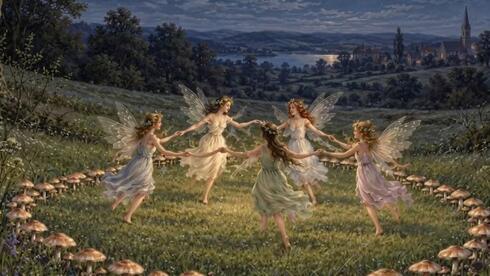
Recent research from Sweden sheds new light on the formation of “fairy rings,” distinctive circles of mushrooms that have intrigued people for centuries. Traditionally attributed to fairies and folklore, these mushroom formations arise from complex interactions beneath the soil rather than appearing spontaneously overnight.
The Mechanism Behind Fairy Rings
A study conducted by researchers at Stockholm University focused on understanding why mushrooms grow in circular patterns instead of spreading evenly. The researchers investigated two fairy rings formed by the fungus *Marasmius oreades* in a cemetery in Uppsala, examining the mycelial network, which consists of thin fungal filaments that can live for years underground.
According to Dr. Hanna Johannesson, the lead researcher, the visible mushrooms represent the fruiting bodies of the fungus, akin to apples on a tree, while the mycelium is the extensive network supporting them below ground. This study confirmed that the rings do not grow uniformly; instead, the mycelium forms a living ring that gradually expands outward. Soil samples collected from the center, edges, and surrounding areas revealed that most fungal DNA was concentrated along the outer edge of the ring.
The study’s findings indicate that the conditions behind the advancing growth front of the mycelium may become unfavorable due to nutrient depletion or the accumulation of inhibiting substances. To explore this further, the researchers transplanted sections of the mycelium to various locations, including the center and outside the original ring. The results, observed after 14 months, suggested that the conditions at the center were not permanently inhospitable, as those sections resumed growing when relocated.
The hypothesis posited by the researchers is termed the “temporary escape” model, suggesting that the fungus must periodically move to new soil due to short-term unfavorable conditions. However, scientists have not yet pinpointed the exact causes of these unfavorable conditions, which could involve nutrient consumption or changes in the surrounding microbial ecosystem.
This research contributes to a broader understanding of fungi and their dynamic growth patterns, revealing that fairy rings are not static but are instead influenced by a variety of environmental factors. The ongoing study of these rings may lead to further insights into the ecology of fungi.
Why It Matters
The discovery of the underlying mechanisms governing fairy rings not only demystifies a long-standing natural phenomenon but also enhances our understanding of fungal ecology. This research highlights the complex interactions within ecosystems, which can have significant implications for biodiversity and agricultural practices.
