




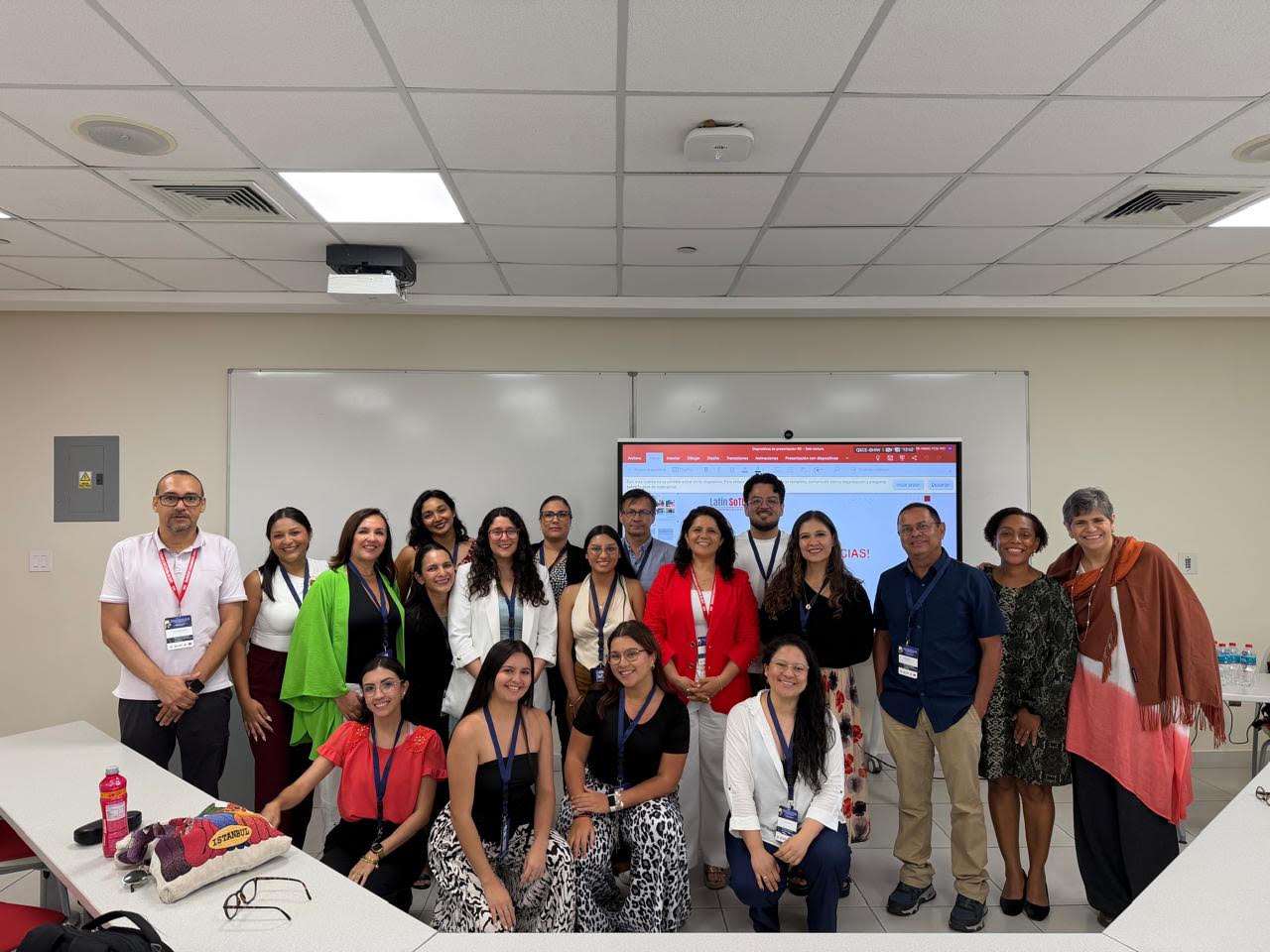
The 4th LatinSoTL Congress focused on the Scholarship of Teaching and Learning (SoTL) from October 24 to 26, 2026, at the Pontificia Universidad Católica Madre y Maestra in Santo Domingo, Dominican Republic. The event gathered academics, researchers, and higher education leaders from across Latin America and the Caribbean, aiming to foster innovation and systematic research in teaching and student learning.
Leslier Valenzuela, an Associate Professor in the Department of Management and Director of the Undergraduate School at FEN, participated in various meetings during the congress and was appointed to lead the LatinSoTL Futuro commission at the closing assembly. Valenzuela presented a paper titled “When Students Change Their Minds: Anonymous Digital Deliberation as a Transformative Learning Experience in Ethics Education.” This work, co-authored with Dr. Claudio Álvarez of Universidad de los Andes and Dr. Gustavo Zurita from FEN, addresses critical challenges in business education, focusing on enhancing ethics teaching through collaborative, experiential learning facilitated by EthicApp, a digital platform employing AI agents.
Valenzuela emphasized the importance of creating safe environments for students to engage in critical discussions, stating, “When we design safe spaces to argue, listen to different perspectives and decide again, ethics stops being just content and becomes a learning experience.”
Professor Verónica Pizarro also contributed to the congress with two presentations. The first paper, “Academic Self-Efficacy in Business Undergraduates: Psychometric Evidence for the ESAA in Chile,” co-authored with Professors Ana Moraga and Vesnia Ortiz from Universidad de La Frontera, investigates self-efficacy among business students within the Chilean context. The second paper, “What the North Doesn’t See: Service-Learning, the SDGs and Territorial Knowledge in Latin American Higher Education,” co-authored with Professors Johan Rivas and Francisco Jofré, explores the connections between service-learning, university education, and the Sustainable Development Goals, advocating for systematic inquiry into everyday teaching practices.
SoTL is becoming increasingly relevant at Universidad de Chile. Prof. Ulrike Kemmerling Weis, the University’s Vice-Rector for Academic Affairs, has voiced support for cultivating a culture where teaching innovation aligns with research and organizational learning, endorsing a new SoTL journal led by Professor Óscar Jerez.
The congress also discussed key topics regarding the future of higher education, including pedagogical innovation, artificial intelligence, and student well-being. Valenzuela remarked that Universidad de Chile’s involvement in the event strengthens an academic agenda aimed at connecting research, teaching, and educational innovation, ensuring that student learning remains at the forefront.
