




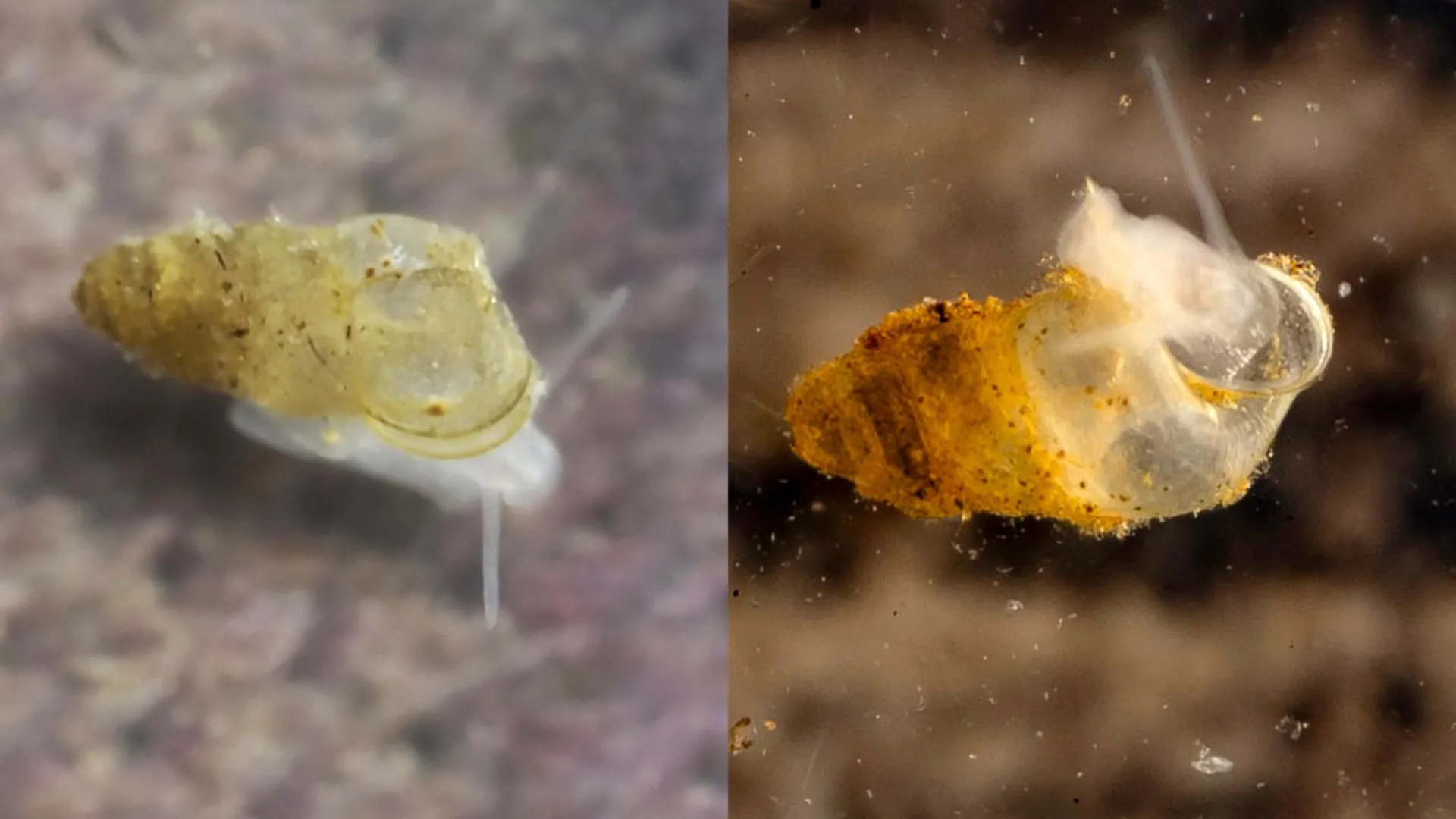
A team of scientists has identified a new species of freshwater cave snail in China, providing significant insights into the obscure aquatic ecosystems found beneath East Asia. The findings, published in the journal Subterranean Biology, highlight the previously undocumented existence of freshwater cave snails in the region and underline the need for further exploration of China’s subterranean mollusks.
The newly discovered species, named Erhaia dijiang, has developed unique adaptations to thrive in total darkness. Notably, it has lost its eyes entirely, and the associated visual structures have degenerated. The snail features a cone-shaped, nearly transparent shell, a delicate body that lacks pigmentation, and long, slender tentacles.
The name dijiang pays homage to “Di Jiang,” a faceless deity from ancient Chinese mythology, as described in the text Classic of Mountains and Seas (山海经). This choice reflects the snail’s notable sensitivity to light; laboratory observations showed that when exposed to illumination, the snails consistently retreated to dark hiding spots beneath rocks.
The discovery site adds to the significance of the finding. Located at an elevation of 2,062 meters, Erhaia dijiang is the highest-altitude cave snail known within the family Erhaiidae. This discovery suggests that freshwater cave snails can inhabit limestone systems at elevations exceeding 2,000 meters.
Within its habitat, Erhaia dijiang resides among submerged gravel and broken rock in water less than one meter deep, where the temperature remains close to 20°C, offering a stable environment. Despite the occurrence of heavy seasonal rains that can increase water flow, snails have not been observed in nearby streams, indicating they remain confined to the cave and typically stay within two meters of its entrance.
Feeding observations revealed that the snails consume diatoms—microscopic algae found on rock surfaces—as well as fish food provided by the researchers.
However, the outlook for the conservation of Erhaia dijiang is concerning. During a field investigation in August 2025, researchers found only three living snails and one empty shell, with no juveniles present, suggesting an alarmingly sparse population. The scientists characterize the species’ future as “far from optimistic.” They are calling for more extensive research of cave ecosystems throughout China to discover additional species and to develop rapid conservation measures for these mollusks, which are native to narrowly confined environments and susceptible to threats.
