




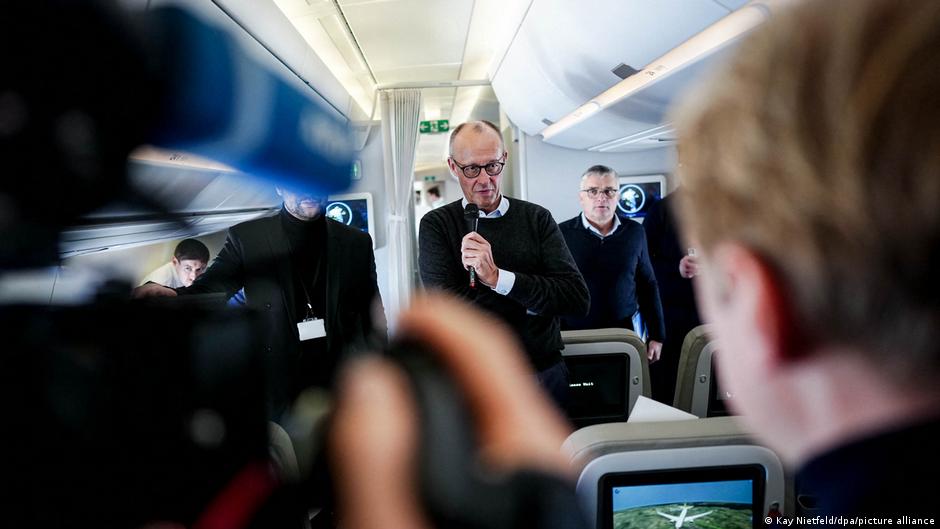
German Chancellor Friedrich Merz began a five-day tour of Asia on Monday, with his first stop in Singapore, followed by scheduled visits to Japan and South Korea. He is accompanied by a delegation of 30 senior business leaders, representing various sectors including industry, technology, defense, and energy.
Simultaneously, German President Frank-Walter Steinmeier is in China. Although their trips are not formally coordinated, both leaders are focused on strengthening Germany’s economic and security ties amid rising geopolitical tensions that threaten global supply chains.
Merz’s Engagements in Asia
In Singapore, Merz plans to deliver a significant foreign policy speech and meet with Prime Minister Lawrence Wong. He will then travel to Japan on Wednesday, where he will hold discussions with Prime Minister Sanae Takaichi and participate in the German-Japanese Business Summit. Ben Ascione, an assistant professor of politics at Waseda University in Tokyo, noted that Merz’s visit comes at a crucial time when Japan is looking to forge new security alliances and deepen trade partnerships.
Ascione remarked, “For more than a decade, Japan has been looking to generate new security allies and closer trade partnerships,” indicating that the current geopolitical landscape has amplified these efforts. He highlighted that both Japan and Germany face distinct but interconnected security threats, with Germany presently focused on the Russian invasion of Ukraine while Japan monitors China, North Korea, and Russia.
China’s increasing assertiveness in the region poses a significant challenge for Japan. Joint military exercises between China and Russia have further heightened concern, particularly regarding Taiwan and other disputed territories in the South China Sea, which could disrupt global trade routes impacting both nations.
Merz and Takaichi are expected to discuss strategies for addressing these geopolitical threats. Japan has welcomed collaboration with Germany regarding military assets as evidenced by previous joint exercises with the German Navy and air force.
After Japan, Merz will head to South Korea to meet with President Lee Jae-myung and open the 19th Asia-Pacific Conference of German Business in Seoul. He is also scheduled to visit the Demilitarized Zone, the heavily fortified border between North and South Korea.
While security concerns will dominate the South Korean agenda, analysts suggest Merz might address South Korea’s recent outreach to North Korea and the potential ramifications of these efforts. According to Saeme Kim, a research fellow at The Asan Institute for Policy Studies, there is European apprehension regarding South Korea’s attempts to engage with North Korea, especially amid allegations of petroleum exports to Russia.
Merz’s visit to the DMZ may also involve viewing North Korea from a distance and could be canceled due to escalating tensions following a mine incident that injured South Korean soldiers. The ongoing situation underscores the complexities surrounding the Korean Peninsula, with lessons from Germany’s reunification holding some relevance for the South.
Merz’s tour aims to strengthen bilateral relations and address mutual concerns with Asian partners about security and economic resilience in a rapidly changing geopolitical environment.
