




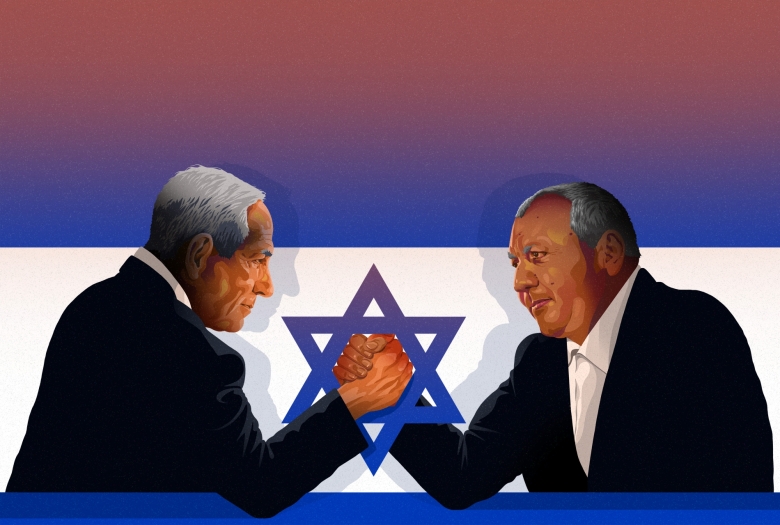
Challenges Ahead in Israel’s Election
Israel’s upcoming election, which operates under a nationwide proportional representation system, presents a complex political landscape. Recent television polls indicate Prime Minister Benjamin Netanyahu’s coalition is projected to secure 50 seats in the Knesset, falling 11 short of the 61 needed for a majority. Meanwhile, the opposition bloc, led by former army chief Gadi Eisenkot, is estimated to secure between 52 and 56 seats, also insufficient for a governing majority.
Although 70 seats oppose Netanyahu on paper, about 20% of those pledging opposition come from parties refusing to collaborate with Arab parties. Avigdor Lieberman, the leader of Yisrael Beiteinu, has completely dismissed any potential cooperation. Eisenkot has not ruled out the possibility of engaging with ultra-Orthodox parties, creating an intricate web of alliances and refusals.
Arab political parties are also divided on their approach to the election. The Ra’am party, which previously participated in the short-lived Bennett-Lapid government, has shown varying degrees of willingness to collaborate with other factions. However, partnering with Zionist opposition parties remains a contentious issue.
The strict electoral threshold of 3.25% of valid votes adds another layer of complexity. Parties falling short of this threshold will not receive any seats, resulting in wasted votes that heighten the difficulty for coalition building. This dynamic has prompted many smaller parties to consider mergers or tactical alliances to avoid falling below the threshold.
Netanyahu’s right-wing bloc has undergone significant restructuring ahead of the 2026 election. His Likud party has absorbed the faction of Gideon Sa’ar to bolster its parliamentary strength. Netayahu’s coalition remains anchored with traditional allies, including the ultra-Orthodox parties Shas and United Torah Judaism, alongside nationalist parties led by Itamar Ben-Gvir’s Otzma Yehudit and Bezalel Smotrich’s Religious Zionist Party.
While Netanyahu aims to create a cohesive front, the far-right factions exhibit divisions that could jeopardize their standing. For instance, Ben-Gvir has resisted efforts to merge with Smotrich’s party, risking potential electoral failure if votes are splintered further.
On the opposition front, a historic coalition has emerged, including a joint ticket from former Prime Minister Naftali Bennett and Yesh Atid leader Yair Lapid. This partnership seeks to capture the support of right-wing voters disillusioned with Netanyahu while avoiding previous pitfalls of fragmentation.
The left-wing parties, represented by Labour and Meretz, have also united under Yair Golan to form The Democrats, offering a renewed message to the electorate.
Meanwhile, Arab representation faced challenges in securing a place on the ballot after initial disqualifications of notable parties by the Central Elections Committee. The Supreme Court intervened, allowing both Mansour Abbas’s Ra’am and Joint List to participate.
The anticipation surrounding the election day is marked by two fortified political blocs, each strategizing to meet the electoral threshold amid an unpredictable political climate characterized by technology and security concerns.
