




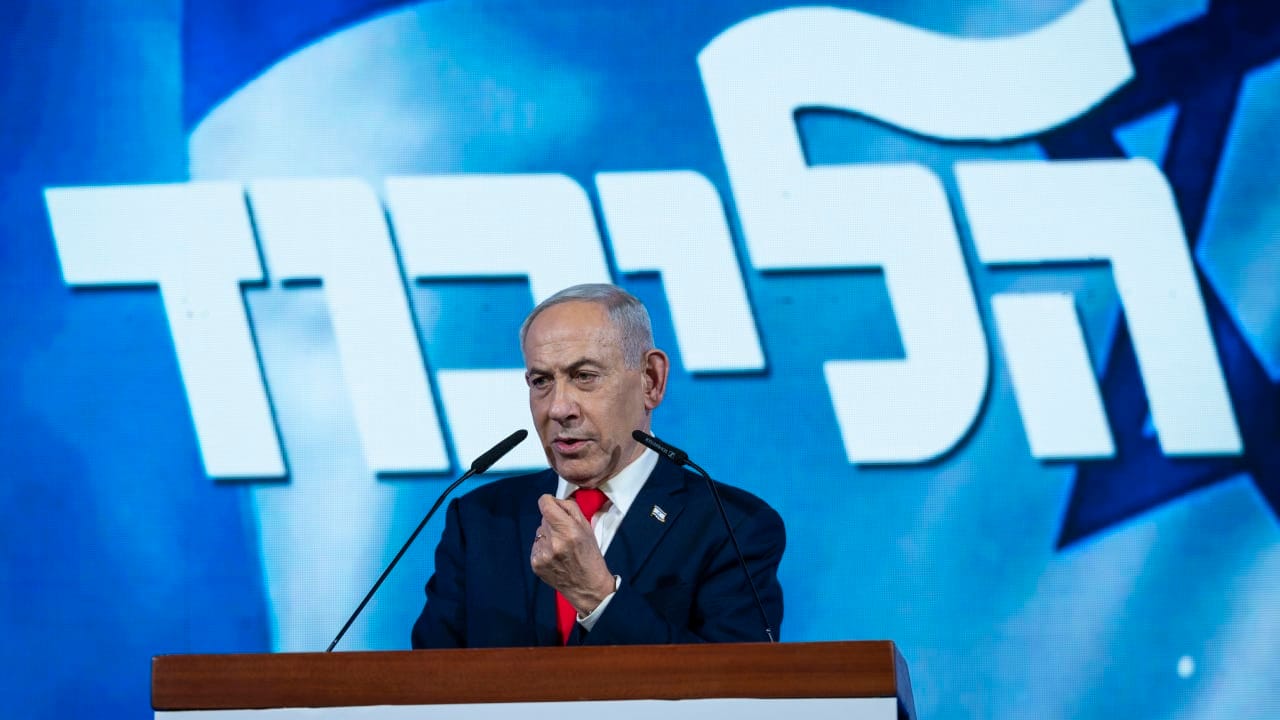
In Israel’s October 27 election, Prime Minister Benjamin Netanyahu’s Likud party appears to have secured the highest number of votes compared to other parties, projected to receive around 26 seats, or 21.7% of the Knesset. Despite this, the political landscape suggests that Netanyahu might not remain in office. The formation of the next government will likely involve negotiations with various parties, some of which may hold differing political ideologies.
Unlike the United States, where voters typically expect the winning presidential candidate to assume office directly and appoint a Cabinet, Israel operates under a parliamentary system. In this system, voters select party lists rather than individual candidates, and the composition of the Knesset, which comprises 120 seats, is determined by the proportion of votes each party receives, given that they surpass a threshold of 3.25% of the vote.
In this election, 38 candidate lists were approved, although one was withdrawn prior to voting. Preliminary results indicate that at least 11 lists will gain entry into the Knesset. These parties span a wide array of political, religious, and social interests, including secular, religious, right-wing, centrist, and left-wing groups. Some advocate for compromises with the Palestinians, while others oppose such measures.
The challenge for Netanyahu lies in securing enough parliamentary support to form a government. As it stands, his traditional right-wing and religious allies are projected to hold 53 seats, falling short of a majority. The opposition, consisting of four parties, is estimated to win 48 seats, while two Arab-led lists are expected to comprise 19 seats. This presents a complex situation: though the opposition might have the seat numbers to replace Netanyahu, several leaders have expressed unwillingness to partner with Arab parties or depend on their support.
Coalition politics in Israel often require extensive negotiations, in which parties must work out agreements over policy and Cabinet positions. The agreements may sometimes lead to alliances between parties that typically do not align on many issues, as was the case in previous elections. For example, in 2021, despite winning fewer seats than Likud, Naftali Bennett, leader of the right-wing Yamina party, managed to become prime minister through coalition negotiations.
The upcoming period will see intense negotiations among the various parties as they strategize about leadership, Cabinet appointments, and government policies. The outcome of these discussions could dramatically reshape Israel’s political landscape. Netanyahu’s ability to attract coalition partners will be crucial, as will be the opposition’s willingness to find common ground to form an alternative government.
