




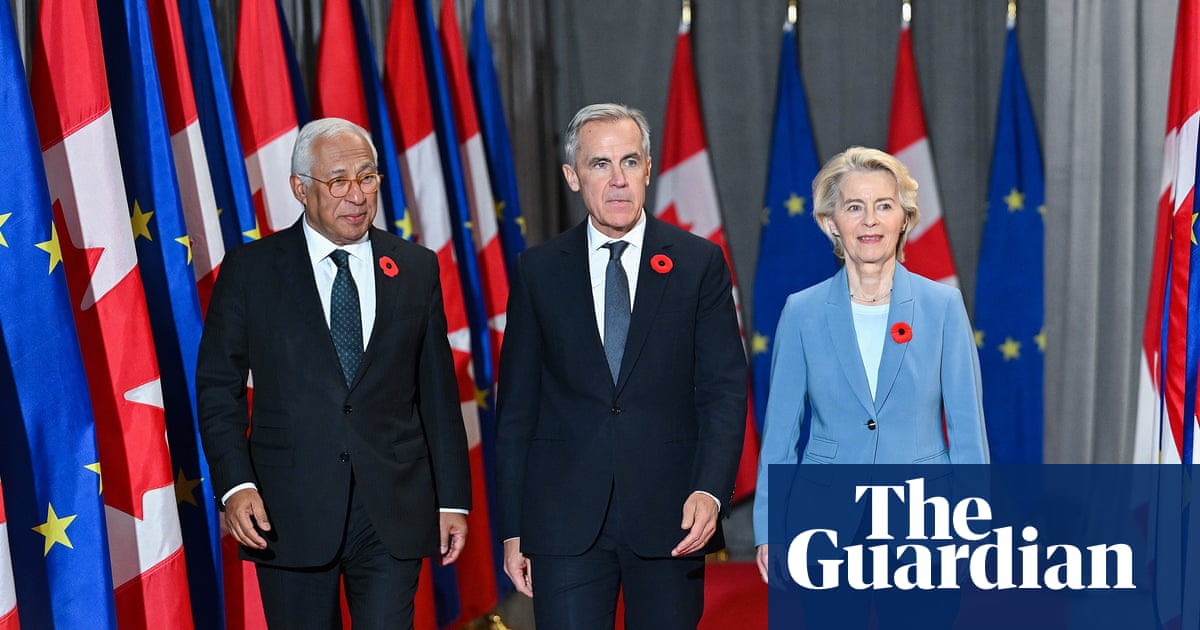
Canada and the European Union have unveiled a new partnership aimed at enhancing geopolitical stability and collaboration, dubbed the Alliance for the Future. During a press conference in Montreal on Friday, Canadian Prime Minister Mark Carney and European Commission President Ursula von der Leyen described the alliance as a “protective canopy” for their citizens while inviting other nations to join.
The leaders emphasized the partnership’s potential to foster unprecedented stability and opportunity, particularly amidst challenges from climate change and the “erosion of democratic norms,” as noted by Carney. He indicated a shared need among nations to counter the unpredictable nature of global politics.
Following a two-day summit, Carney and von der Leyen discussed future initiatives aimed at creating a more integrated market worth billions, reducing trade and travel barriers, and establishing new educational exchanges. This partnership emerges as Canada seeks to diversify its economic alliances in the face of ongoing tensions with the United States, especially regarding trade and defense dependencies.
Recently, Carney has raised concerns about Canada’s heavy reliance on American technology, particularly in defense. His apprehensions were highlighted by a recent incident where Elon Musk limited the services of Starlink over Ukraine, affecting its military operations. Musk, who holds Canadian citizenship, has previously criticized the Canadian government, further complicating defense discussions.
In a move to bolster its artificial intelligence capabilities, Canada is pursuing a merger between Canadian firm Cohere Inc. and Germany’s Aleph Alpha GmbH. The new entity will have dual headquarters in Toronto and Berlin, with the Canadian government investing up to C$1.6 billion in Cohere. “We are not waiting for the future of AI to be decided somewhere else by those we don’t know, or by whom we don’t trust,” Carney stated.
During the summit, Canada was also welcomed into Europe’s supercomputing network, gaining access to advanced European AI training resources. This step aims to create competitive economic conditions and address rising living costs, as highlighted by von der Leyen. She noted that when trade is used as a tool for pressure, it is families who ultimately bear the burden from rising prices on essential goods.
The potential for Canada to become an associate member of the EU was a key topic of discussion, though the designation remains controversial among certain EU nations. European Council President Antonio Costa expressed strong support for the idea, stating that Canada shares core values with the EU despite geographical distance. He emphasized the ambition to forge the closest possible relationship between a non-European country and the EU.
The summit, however, has not been without criticism. Quebec Premier Paul St-Pierre Plamondon of the separatist Parti Québécois declined to attend, citing frustrations over the federal government’s failure to grant him a platform to express Quebec’s interests during the event. His absence underscores ongoing tensions regarding Quebec’s role in national dialogues.
As the partnership develops, leaders aim to clarify Canada’s associate membership role during a scheduled summit in 2027.
