




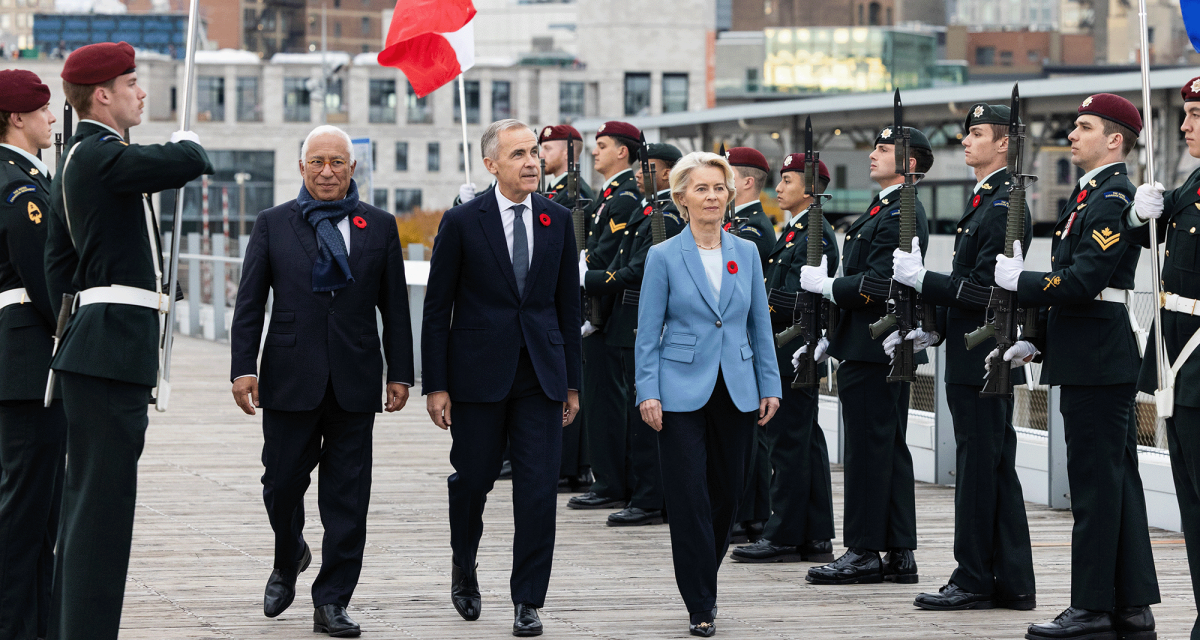
Canadian Prime Minister Mark Carney is meeting with leaders from the European Union in Montréal this week to establish a new strategic partnership, which he describes as “a beacon for other democracies.” This summit aims to forge closer ties between Canada and Europe, a move Carney has championed since taking office.
Carney views Brussels as a crucial ally in rebuilding the international order, emphasizing that the EU’s relationship with Canada is its oldest formal connection with any industrialized country. However, he acknowledges challenges facing the EU, including sluggish economic growth and internal divisions related to budget negotiations and geopolitical issues, particularly surrounding Ukraine. In 2025, the EU’s real GDP grew by only 1.5%, with projections of 1.4% growth for 2026, according to the International Monetary Fund (IMF).
In contrast, the Asia-Pacific region is projected to experience significantly faster growth, with the IMF estimating real GDP growth of 4.8% in 2026. This presents a lucrative market for Canadian exporters and investors. The Indo-Pacific region boasts over four billion inhabitants, far surpassing the EU’s 450 million. Carney’s government is actively pursuing trade agreements with ASEAN nations, India, and the Philippines, and seeks to enhance relations with both India and China.
During the summit, Carney reiterated that a new Canada-EU alliance would be inclusive, potentially inviting other nations like Australia, Japan, New Zealand, and South Korea to join. This initiative is consistent with Canada’s strategy to integrate European and Asia-Pacific partnerships, particularly through initiatives associated with the Comprehensive and Progressive Agreement for Trans-Pacific Partnership (CPTPP).
Fostering Deeper Connections
Carney’s diplomatic approach is rooted in historical ties and shared values. He has underscored the importance of common principles, such as rule of law and human rights, which resonate with both Canadian and European philosophies. In a recent speech to EU lawmakers, Carney stated that these values share deep historical roots in both regions.
Carney’s commitment to enhancing Canada’s relationships in Europe follows his first official trip to France as Prime Minister and numerous discussions with his British counterpart. His background as a former governor of the Bank of England has cultivated extensive personal connections in Europe.
Defence, security, and cooperation in technology and critical minerals are also central themes in the Canada-EU relationship. Carney’s administration has emphasized integration with European security initiatives, as illustrated by the decision to select a German company for a prominent submarine contract.
As Canada looks to balance its involvement in Europe and the Indo-Pacific, this week’s summit is seen as a critical platform for strengthening alliances while navigating the complexities of international affiliations and trade-offs between values and economic interests.
