




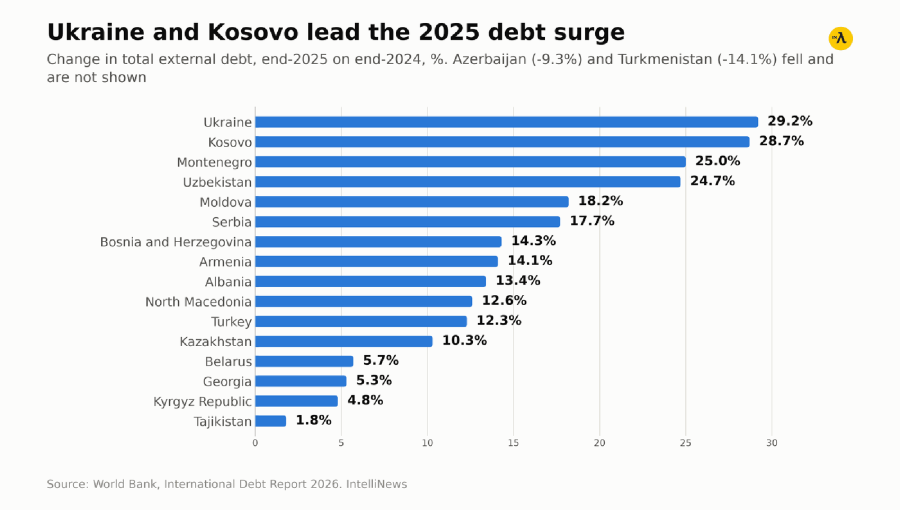
External debt in developing Europe and Central Asia rose by 15.3% to reach $1.34 trillion in 2025, according to the World Bank’s International Debt Report 2026. This increase marked the fastest growth among developing regions, primarily fueled by significant borrowing in Ukraine and Turkey.
The 18-country group collectively added approximately $178 billion in external debt over the year. In comparison, low- and middle-income countries overall saw a smaller increase of 5.5%, bringing total debt to a record $9.4 trillion. Sub-Saharan Africa recorded a 10.8% rise in debt, while East Asia and the Pacific experienced a decline of 1.8%, chiefly due to a contraction in China.
Within the Europe and Central Asia group, which includes the Western Balkans, Eastern Europe (excluding the EU), Turkey, the South Caucasus, and Central Asia (excluding Russia and EU eastern members), the servicing capacity for debt fell short of the growing obligations. External debt represented 152.2% of the region’s exports, a 14.7 percentage point increase from 2024—the highest deterioration among developing regions. Interest payments consumed 6.8% of export earnings, the highest ratio in the region, while overall debt service climbed to 24.8% of exports, up from 22.9%.
Ukraine’s external debt rose 29.2% to $250.3 billion, the highest percentage increase of the ten largest developing-country borrowers outside China. In terms of exports, Ukraine’s debt reached 403%, while its national income ratio stood at 118%. The European Union held a significant portion of Ukraine’s debt, accounting for $82.3 billion of the $131.6 billion owed to multilateral creditors.
Turkey, the largest debtor in the region, saw its external debt increase by 12.3% to $572.8 billion. The Turkish public sector issued $27.7 billion in bonds in 2025, ranking second among developing countries, while private companies raised $23.5 billion. Turkey’s short-term external debt reached $165.8 billion, representing 29% of its total external debt.
Central Asian countries exhibited varied trends. Uzbekistan’s external debt surged over sixfold since 2015, reaching $88 billion after a 24.7% rise in 2025. Conversely, Kazakhstan faced a considerable debt service ratio of 64% of exports, although much of its external debt was owed by private companies, amounting to $183.1 billion.
The report also noted significant increases in the Western Balkans and Moldova, with Kosovo’s debt rising 28.7% and Montenegro’s by 25%. Azerbaijan was an exception, with its external debt decreasing by 9.3% to $12.3 billion.
As 2026 progresses, borrowing continues in the region, with more than ten developing countries exceeding their full-year 2025 bond issuance by mid-August. Bosnia and Herzegovina, for instance, raised $1.8 billion, a stark contrast to the $412 million borrowed in the previous year.
