




Recent advancements in optics have led researchers to explore the generation of secondary vortices from collisions between spatiotemporal optical vortices (STOVs). When two STOV pulses, each defined by specific topological charges, collide, they create complex interaction patterns characterized by new phase singularities.
During these collisions, the superposition of the two pulses can produce secondary vortices that arise at points where the combined field amplitude reaches zero, creating undefined phase areas. The formation of these secondary vortices is influenced by the difference in their topological charges, determining their number and arrangement. For example, a collision involving one pulse with a charge of +3 and another with -3 can generate up to six secondary vortices, resulting in a structured intensity landscape in the spatiotemporal domain.
The geometrical layout of these secondary vortices resembles a comb-like structure, termed the Spatiotemporal Hollow Comb (STHC), due to its periodic intensity distribution. The positioning of these vortices and the characteristics of the resulting fields can be modulated through phase offsets between the two STOV beams. Researchers found that adjusting the phase on a subwavelength scale allows for the generation of various dynamic configurations of the secondary-vortex arrays.
Experimental setups utilized femtosecond pulse lasers, enabling detailed observation of the interactions between STOVs. By examining the spectral domain during these collisions, scientists were able to identify distinct signatures corresponding to different collision parameters, enhancing the understanding of underlying physical phenomena.
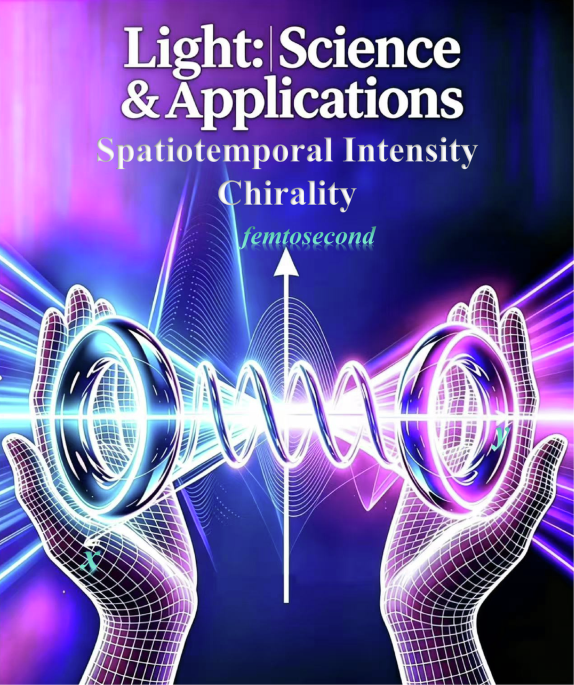
Further investigation revealed that when STOVs collide at a slight angle, they can produce a helical structure known as the Spatiotemporal Optical Coil (STOC). This phenomenon is facilitated by introducing a linear phase gradient along the transverse direction, which modifies the configuration of the secondary vortices into a three-dimensional helix. The resulting STOC’s helical properties, such as the number of arms and pitch, are affected significantly by initial collision parameters, including the topological charge difference and collision angle.
The implications extend to potential applications in optical chirality, where energy flow characteristics are intrinsically linked to how light interacts with matter. The intensity distribution of this helical structure introduces a novel form of chirality that is distinct from traditional methods reliant on polarization or phase. This new optical chirality opens avenues for targeted manipulation of particles, harnessing the complex energy flow patterns created during STOV collisions.
The research underscores a transformative approach to understanding light behavior and its interactions, paving the way for innovations in optical technologies and applications in photonics. Upcoming studies are expected to delve deeper into the practical applications of these findings, particularly in the realms of controlling chiral interactions and enhancing light-based manipulation techniques.
