




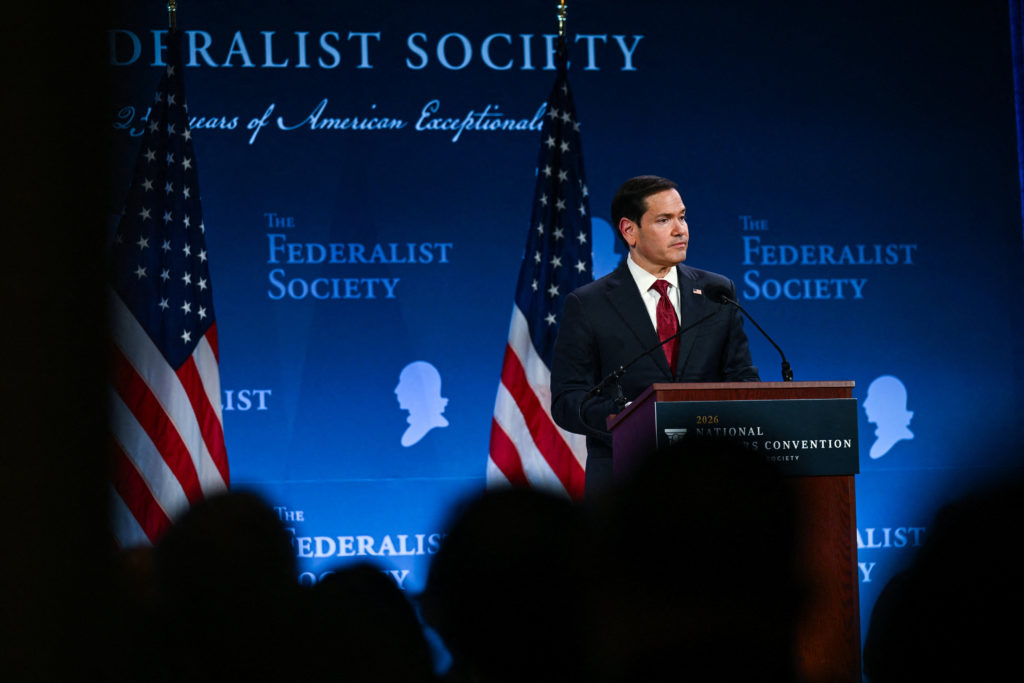
WASHINGTON — Secretary of State Marco Rubio addressed fellow conservatives at the Federalist Society’s National Lawyers Convention on Friday, acknowledging the economic struggles faced by many Americans and condemning the “weaponization” of international law that he claims restricts U.S. interests. His speech comes in the backdrop of significant losses for the Republican Party in recent elections, where economic issues were a primary concern for voters.
“I think we have to recognize that people are struggling. There’s no doubt about it,” Rubio stated. He criticized the notion that stock market performance is a true reflection of economic health, emphasizing that the well-being of Americans hinges on their ability to afford basic necessities.
This sentiment contrasts sharply with former President Donald Trump’s frequent references to the stock market as an indicator of economic success. Many voters, frustrated by rising costs linked to Trump’s tariffs and foreign policy decisions, shifted control of Congress to Democrats.
Rubio’s remarks had a campaign-like tone as he navigated issues surrounding the economy while also hinting at potential future ambitions, though he has not publicly confirmed any plans to run for president in 2028. Last month in Greece, he delivered a speech that suggested his aspirations extend beyond his current diplomatic role.
During his address, Rubio defended the U.S. military intervention in Iran, asserting its necessity in preventing the country from acquiring nuclear weapons. However, he acknowledged the conflict’s impact on domestic fuel prices, stating, “It’s not easy to address these things because it’s not popular to address them. It’s difficult.”
He underscored the importance of ensuring economic prosperity for future generations, warning that the U.S. might be the first generation to leave subsequent generations worse off. “That can’t happen. That’s un-American,” he said.
Rubio also criticized the international community’s response to U.S. policies, particularly those from the Trump administration, which faced accusations of violating international law during foreign interventions. He described these criticisms as part of a broader trend, labeling it as the “weaponization of international law” aimed at undermining U.S. sovereignty.
He took aim at various international organizations, including the United Nations and the International Criminal Court, accusing them of attempting to limit U.S. autonomy. “They lecture us on the importance of sovereignty, even as they demand that nations surrender control of their borders,” he remarked.
Rubio’s address reflects ongoing tensions surrounding U.S. foreign policy and the domestic economic climate, highlighting the complexities facing leaders as they navigate these intertwined challenges.
