




Researchers at the University of Pennsylvania have developed advanced artificial muscles that emulate the movement capabilities of human muscles, focusing particularly on the small muscles found in the eyes and fingers. Their findings were published this week in the journal Advanced Functional Materials.
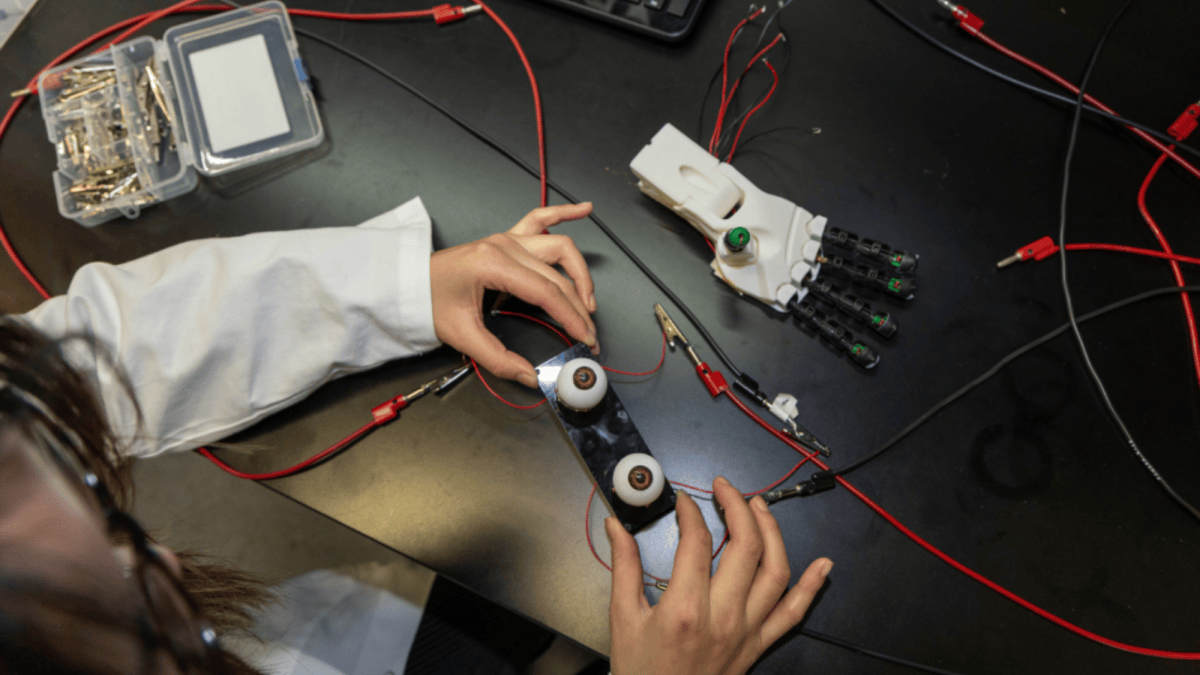
The team conducted experiments where a robotic hand played piano keys with varying intensity, while artificial eye muscles demonstrated the ability to maintain focus. This research is part of ongoing efforts to enhance the lifelike qualities of humanoid robots.
Creating functional robot muscles poses significant challenges, particularly due to the rigid motors most large robots currently utilize. These motors can perform straightforward tasks but lack the precision needed for delicate movements, such as those executed by human fingers or eyes. “Soft robotic muscles need to be both strong and flexible to mimic human movements, but these properties are rarely found in the same material,” said Shu Yang, a co-author of the study.
The engineers selected liquid crystal elastomers (LCE) combined with graphene and a thin copper coil to develop their artificial muscle fibers. The LCE serves as the muscle, contracting and stretching, while the graphene strengthens it, allowing for movement despite external tension. However, the LCE tends to revert to its original shape after stretching, complicating the execution of precise movements like sustaining a gaze or pressing piano keys lightly.
To address this, the researchers incorporated the copper coil as a temperature sensor, monitoring heat levels to maintain precise muscle positioning. Xuelin Wu, a Ph.D. student involved in the project, explained that “the coil served as both a heater and a sensor, so we did not need a separate sensor for feedback.”
In practical tests, the newly developed muscles were installed in a 3D-printed robotic hand, allowing it to press piano keys at different forces and speeds. While the results were not perfect, they demonstrated the potential to mimic human touch. Additionally, robotic eyes were constructed to track movements accurately, showcasing controlled gaze shifts through the muscle technology.
This work is part of a broader trend where laboratories and companies are racing to innovate artificial muscle systems. For instance, the Polish startup Clone Robotics showcased its approach with a musculoskeletal android, utilizing a combination of synthetic muscles and hydraulic systems. Although still in early stages, their project illustrates the potential future of robots replacing traditional motors with more human-like muscle technologies.
Looking forward, the University of Pennsylvania team aims to integrate multiple artificial muscles into cohesive systems capable of more complex movements and expressions. They are also exploring the use of AI computer vision for better coordination of these systems. Ziyun Zhang, another co-author, expressed enthusiasm for this direction, stating a desire to create robots that exhibit the subtlety and expressiveness characteristic of human actions.
