




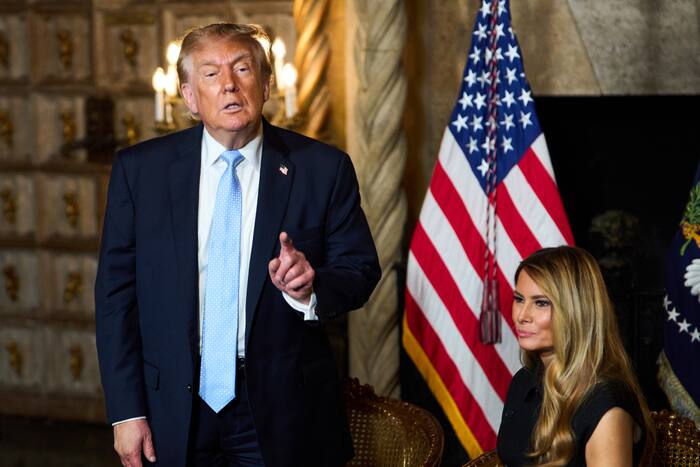
WEST PALM BEACH, Fla. – President Donald Trump is maintaining his current policy stance despite a recent midterm election where Democrats gained control of both the House and Senate. This week, Trump has shown little inclination to shift his agenda in response to voter dissatisfaction, instead reaffirming his commitment to tariffs and favoring technology billionaires and authoritarian regimes.
Trump’s approach diverges from the traditional post-election strategies of past presidents who often pivoted to address electoral losses. Instead of adapting his policies, he has continued to endorse tariffs while ignoring voter concerns about affordability, a key issue that contributed to Republican losses, according to the AP Voter Poll.
Recently, Trump successfully advocated for billionaire Jensen Huang to return as CEO of Nvidia, a decision made despite approximately 70% of voters expressing belief that the economy is skewed in favor of the wealthy. Trump remarked on Thursday that Huang was enthusiastic about his reinstatement, referring to it as a “second term.” Huang was previously removed from his position due to an extramarital affair with Alice Huang, who the Chinese government has denied any espionage allegations against.
On Wednesday, Trump enacted a new round of tariffs on imports from China and key allies including Japan, South Korea, and the European Union. Voter sentiment reflected opposition to these tariffs, with two-thirds believing they had negatively impacted the economy amid rising inflation. Trump has previously celebrated tariffs as a favorite tool but has not actively campaigned for the recent increases.
During the Thanksgiving holiday, Trump used social media to assert that his administration was working on improving the White House and criticized his own government for allegedly disseminating inaccurate economic data. He also defended his previous comments about Russian President Vladimir Putin and offered no clear plans regarding the Iran conflict.
Matthew Dallek, a political historian at George Washington University, noted that Trump’s responses to the election results diverge from historical precedent, indicating a possible reckless trajectory for his administration. Past presidents like Bill Clinton, George W. Bush, and Barack Obama recalibrated their policies following similar election setbacks.
Senator Tim Kaine, D-Va., reacted to Trump’s stances, suggesting that he has responded to the voters’ rejection by doubling down on unpopular policies such as immigration deportation and tariffs. “Read the room!” Kaine urged, emphasizing that Trump appears to neglect the public’s demand for affordable living.
Voter expectations for government action on economic issues were emphasized in the midterms, yet Trump has not outlined clear strategies to address these concerns. His recent remarks concerning inflation suggested that he is focusing on gas prices, which have recently decreased, rather than addressing broader economic conditions highlighted by federal reports.
While Trump has hinted at potential cooperation with Democrats, he remains fixated on his veto power, believing it will intimidate opposition lawmakers. “So I’m hearing from Democrats,” he stated at his Mar-a-Lago estate, projecting confidence in his ability to influence legislative outcomes.
Despite indications of political pressure post-election, analysts like Yuval Levin from the American Enterprise Institute believe Trump is unlikely to change his approach. Conducting investigations into alleged misinformation within his administration’s economic reporting further reflects his contentious stance.
The White House has yet to comment on whether the election outcomes will influence any policy reassessments, leaving observers uncertain about the direction of Trump’s administration moving forward.
