




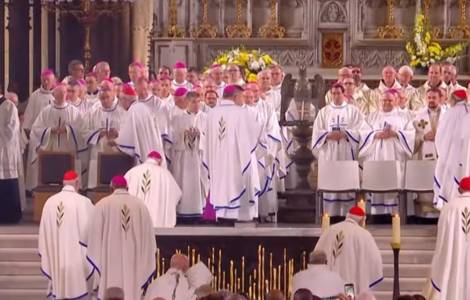
Ars-sur-Moselle, France – Bishop Aldo Berardi, Apostolic Vicar of Northern Arabia, reflected on the significance of Pope Leo XIV’s recent visit to Metz, held on September 28. The Bishop, who hails from the nearby town of Ars-sur-Moselle, highlighted the occasion as an opportunity to relate the historical struggles of his homeland to the ongoing conflicts faced by communities in Ukraine, the Holy Land, and the Gulf region.
“I experienced this event with great emotion and deep involvement, together with all the other bishops who were present, including those from other countries,” Bishop Berardi told Fides News Agency. He participated in discussions on Europe and interreligious dialogue inspired by Robert Schuman, a founding father of the European Union, as well as at a Holy Mass at St. Stephen’s Cathedral.
During the Mass, he sat next to Bishop Ihor Rantsya, Byzantine Catholic Bishop of Ukrainian Catholics, recently appointed Eparch of Saint Volodymyr the Great in Paris. For those affected by conflict, including Berardi, the Pope’s appeals for peace and reconciliation carried particular weight. “For us, experiencing war at home, his call resonated strongly,” he said.
Bishop Berardi observed that the historical context of Metz and Lorraine, a region scarred by wars and divisions, offers valuable lessons in reconciliation. “The destruction caused by the three wars made the process more difficult, yet it was eventually achieved by the founding fathers of Europe,” he explained. This led him and Bishop Rantsya to ponder whether similar paths to reconciliation could be pursued in places like the Middle East and Ukraine.
The Bishop acknowledged that the journey to reconciliation was fraught with challenges. “The history of these lands speaks of deep wounds, including young men forcibly enlisted and deportations,” he noted. He emphasized that Franco-German reconciliation did not occur overnight, describing it as a painful process involving significant struggles for forgiveness among the local population.
He interpreted Pope Leo XIV’s message as a source of hope, emphasizing the need for goodwill, forgiveness, and justice while addressing practical concerns such as land rights and community equality. Bishop Berardi believes this call to reconciliation is relevant for Christian communities across the Gulf, Ukraine, and the Holy Land: “We will reflect on this message in our communities, recognizing it as the beginning of a long but crucial journey.”
For Berardi, the realities of war are not distant. His own church in Ars-sur-Moselle was bombed, and the town still bears the scars of past conflicts. “Every situation of war and conflict touches me deeply. Eighty percent of the village was destroyed,” he shared. He is acutely aware of the ongoing impacts of war, particularly in the Gulf, where he explained the nuanced nature of current conflicts involving targeted strikes and economic warfare, rather than classic military engagements.
Despite hopes for peace, the Bishop cautioned that achieving an end to hostilities does not guarantee reconciliation. “Peace on paper does not mean healing the deep-rooted wounds among the population,” he explained, noting the ongoing tensions among various ethnic and religious groups.
The visit to Metz also fostered camaraderie among clergy facing similar challenges in conflict-ridden areas. “For me, it was a moment of peace and reflection,” he said, appreciating the exchange of experiences with fellow bishops. He concluded by highlighting the Cathedral of Metz as a symbol of diversity and unity, representing hope for reconciliation across cultures.
