




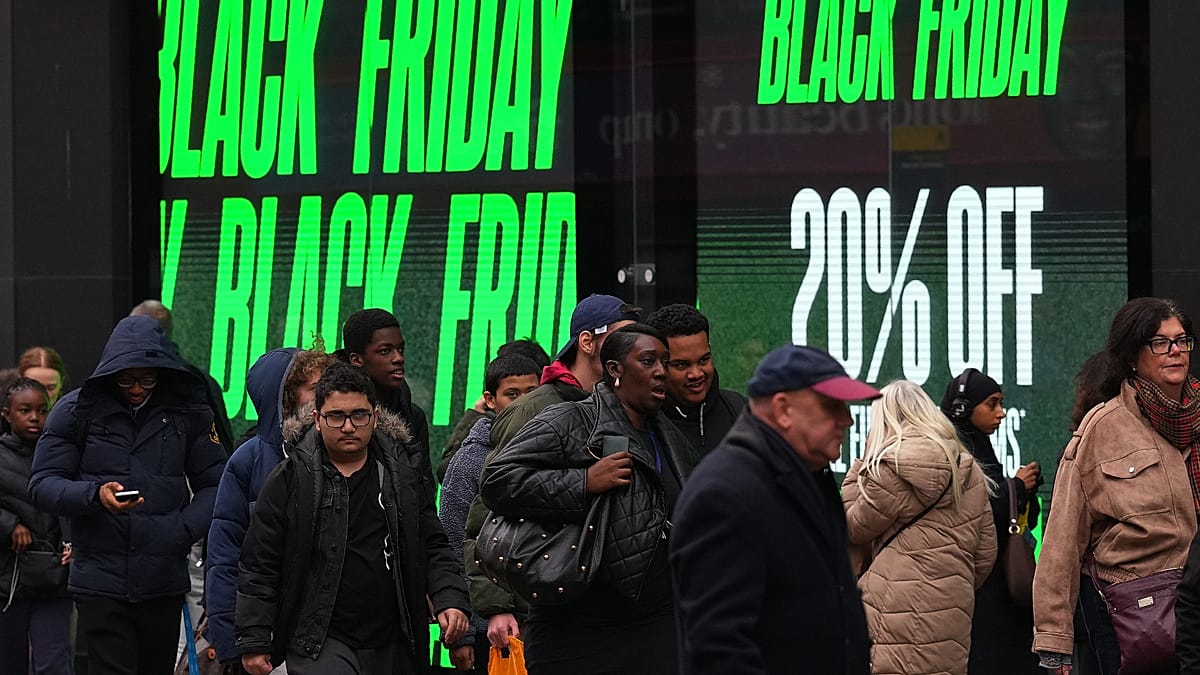
Shoppers across Europe are showing mixed signals as Black Friday promotions flood shop windows from Lisbon to Warsaw. However, consumer sentiment appears cautious as new data reveals varying levels of financial optimism among EU households.
On the same day as Black Friday, the European Commission released its monthly consumer survey, which gauges how households feel about their finances and economic expectations for the upcoming year across all 27 EU member states. The survey, which combines responses to four key questions, showed a confidence indicator for the euro area at -16.9 for November, reflecting a slight improvement from October’s -17.9 but remaining significantly below the historical average of -10.7.
The rising cost of living is influencing consumer attitudes. According to Eurostat, consumer prices in the euro area increased by 4% year-over-year as of October, with energy costs driving much of this inflation.
Greece Exhibits Deepest Gloom
Among the EU nations, Greece reported the lowest consumer confidence, scoring -50.5 in November—down from -48.9 the previous month. Romania follows with a -29.7, while historical averages place Greek consumer sentiment at -40.5. Inflation in Greece reached 5.7% in October, the fourth-highest in the EU, contributing to the somber outlook.
Romania, Estonia (-29.2), Bulgaria (-28.4), and both Italy and Portugal (-24.9) also reflect significant pessimism. Notably, Estonia’s reading is nearly 18 points below its historical average, marking the widest gap among EU nations.
Italian Consumers Hesitant on Major Purchases
Italy’s consumer sentiment also declined sharply, with confidence plummeting from -40.4 to -46.5. This drop indicates heightened caution regarding large purchases, with only Romanian households expressing greater reluctance. Italy’s overall consumer confidence is now at its lowest in a year, scoring -24.9.
Conversely, Lithuania and Malta stand out as the only countries where consumers anticipate increased spending on major purchases over the next year, with confidence readings of 5.0 and 2.9, respectively.
Optimism in Malta, Spain, and Lithuania
Spain registered its highest confidence level in over a year at -1.1, while Lithuania closely follows at -1.4. Hungary (-5.1) and Sweden (-7.7) round out the top five performers. Interestingly, Hungarian consumers’ sentiment has improved significantly compared to their historical average.
Overall, eight EU countries now exceed their respective long-term confidence averages, including Malta, Spain, Lithuania, Hungary, Czechia, Luxembourg, Croatia, and Poland. Meanwhile, Slovenia tracks at its average, while 18 countries remain below their norms.
Major Economies Show Mixed Sentiment
Germany’s confidence reading is at -14.3, slightly improved from October. France saw an improvement to -20.2 from -21.9, while the Netherlands dropped to -16.6 from -19.0. According to economist Melanie Debono from Pantheon Macroeconomics, reduced fuel taxes have not significantly lifted morale among German consumers.
In the euro area, households are trending towards saving rather than spending. The balance of savings intentions rose to 10.0, compared to a historical average of -2.9, with Luxembourg leading at 52.6. Although consumers expect easing price rises, as noted by the balance of price expectations dropping to 30.0, many are still exercising caution with their purchasing decisions.
This hesitation in consumer spending presents a significant challenge for retailers as they navigate the current economic landscape, particularly on a traditionally high-spending day like Black Friday.
