




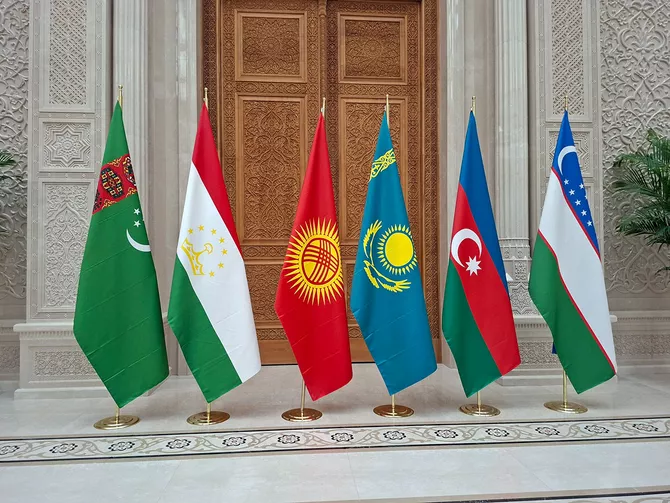
Azerbaijan’s foreign policy increasingly emphasizes its role in Central Asia, driven by the country’s strategic geographic position and historical ties. This shift reflects Azerbaijan’s intention to act as a bridge between the South Caucasus and Central Asia, facilitating political, economic, and cultural connections.
Geographical and Economic Significance
President Ilham Aliyev highlighted that Azerbaijan and Central Asian nations share a ‘single historical, cultural, geographical, and geopolitical space.’ This approach sees the Caspian Sea not merely as a boundary but as a crucial conduit for economic integration. The historical and cultural affiliations, language ties, and transportation links emphasize Azerbaijan’s role in connecting Central Asia with Europe and beyond.
Several factors contribute to Azerbaijan’s growing importance to Central Asian countries. Firstly, the region provides strategic depth for Azerbaijan towards Asian markets, particularly China. As the economic potential of nations like Kazakhstan, Uzbekistan, and Turkmenistan continues to rise, Azerbaijan stands as a natural partner for various transport and energy projects. Furthermore, Central Asian countries’ demands for alternative trade routes enhance the relevance of Azerbaijan’s transportation and energy infrastructure.
Azerbaijan serves as a vital transit point for Central Asian goods aimed at European markets. The Caspian Sea, Baku International Sea Trade Port, and the Baku-Tbilisi-Kars railway offer streamlined access, making Azerbaijan a key player in regional trade. Recent global disruptions have further emphasized the importance of these routes, signaling a long-term shift in trade dynamics rather than a temporary change due to geopolitical crises.
Azerbaijan’s foreign policy diversification also plays a role in its engagement with Central Asia. By fostering relationships with a range of global powers, including the U.S., Europe, and Turkey, Azerbaijan aims to mitigate dependence on any single entity. The mutual interests in sovereignty, territorial integrity, and a commitment to multi-vector diplomacy further shape the political landscape between Azerbaijan and Central Asian states.
The relationship between Azerbaijan and Central Asia has evolved beyond conventional diplomacy to a model of functional regionalism. Establishing mutual cooperative ties across various sectors reflects a commitment to increasing interdependence while maintaining sovereignty. Azerbaijan’s treaty partnerships with each Central Asian state bolster political dialogue and create a framework for ongoing collaboration.
A notable milestone in this relationship is Azerbaijan’s recent inclusion in the Consultative Meetings of Heads of State of Central Asia. This participation marks a transition from Azerbaijan as an external partner to a full member engaged in shaping regional policy on transport, energy, and humanitarian matters.
The emerging interconnectedness of geopolitics and geoeconomics suggests that Azerbaijan and Central Asia are on the path to becoming an integrated regional space. As collaboration deepens across multiple sectors, Azerbaijan’s strategic importance within Central Asia continues to grow, supported by shared history, culture, and increasing economic ties.
Why It Matters
The evolving relationships between Azerbaijan and Central Asia reflect a significant geopolitical shift that could reshape trade routes and economic partnerships in the region. As global dynamics change, Azerbaijan’s role in Central Asia could serve as a critical nexus for transportation and energy, impacting various international markets and contributing to regional stability and cooperation.
