




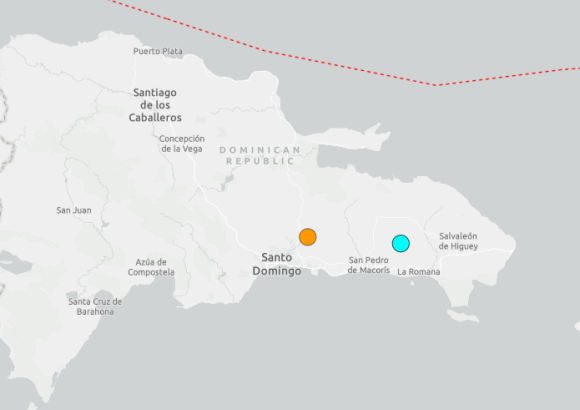
Santo Domingo – On Sunday, September 27, the Dominican Republic experienced multiple earthquakes, the most significant of which occurred in the eastern region of the country, according to seismic data. The first noticeable tremor was detected at approximately 6:06 a.m. local time, near Bayaguana, Monte Plata. The U.S. Geological Survey reported this earthquake measured 4.2 in magnitude, with its epicenter located about 13 kilometers (8 miles) south-southwest of Bayaguana.
Subsequently, the National Seismology Center of the Autonomous University of Santo Domingo (UASD) recorded another earthquake around the same time, reported to be of magnitude 4.3. This quake occurred near San Antonio de Guerra in the Santo Domingo province, at a depth of approximately 95.7 kilometers, and was felt across various parts of Greater Santo Domingo.
Reports indicated that the quake was perceptible in several additional provinces, including Monte Plata, San Cristóbal, San Pedro de Macorís, Hato Mayor, Sánchez Ramírez, Monseñor Nouel, and El Seibo. At the time of reporting, there were no confirmed casualties or significant structural damage linked to these initial events.
Later in the day, seismic activity intensified with a stronger earthquake documented in the eastern Dominican Republic. Volcanodiscovery reported a magnitude 5.2 earthquake approximately 8 kilometers southeast of Ramón Santana in the San Pedro de Macorís area, which occurred at around 5:49 p.m. Dominican Republic time.
As of now, updates indicate that there have been no reports of serious damage or injuries as a result of the earthquakes experienced on Sunday. The Dominican Republic is situated in a seismically active area within the Caribbean, where several tectonic structures contribute to ongoing earthquake activity. Local authorities and seismological institutions actively monitor these occurrences, providing updates as new information comes to light.
Seismic Activity Monitoring in the Dominican Republic
Seismologists consistently observe that the Dominican Republic’s geographic location subjects it to frequent seismic events. The government and relevant agencies work diligently to ensure public safety and preparedness in the face of such natural occurrences.
Why It Matters – Understanding the seismic risks in the Dominican Republic is vital for the safety and preparedness of its residents. Continuous monitoring and rapid reporting of seismic events help mitigate potential hazards associated with earthquakes in this vulnerable region.
