




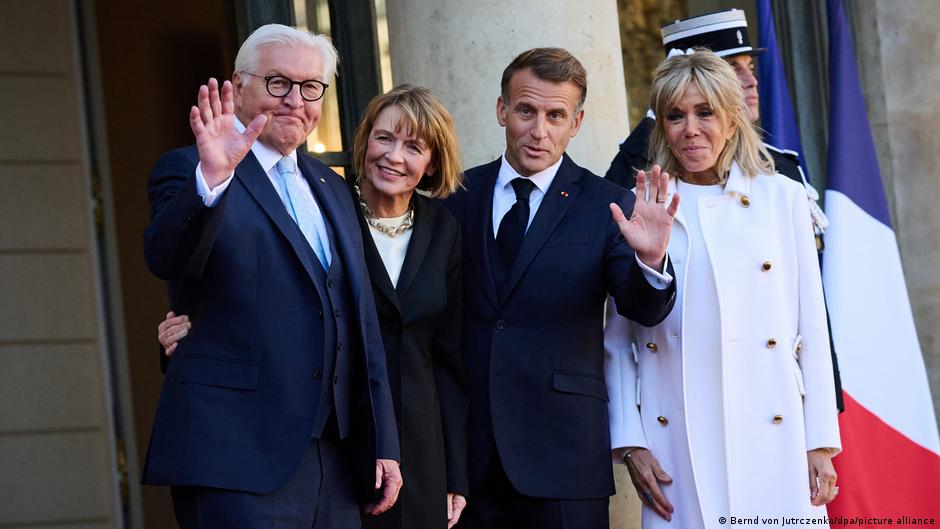
The German delegation’s visit to Paris concluded without interruption from ongoing student strikes in the city. Motorcades moved smoothly through Paris, although traffic was severely congested around iconic sites like the Arc de Triomphe and Champs-Élysées due to extensive security measures in anticipation of the high-profile visit.
French President Emmanuel Macron paid special tribute to German President Frank-Walter Steinmeier during the visit, hosting a ceremonial send-off under the Arc de Triomphe. The German national anthem echoed through the Paris landmark early in the morning, contrasting the sunny yet cold weather.
This ceremony symbolized friendship between the two nations, amidst rising support for populist movements in both countries. Currently, the far-right Alternative for Germany (AfD) tops national polls in Germany, while Macron’s future could pivot toward candidates like Jean-Luc Mélenchon or Marine Le Pen in France.
Macron underscored the economic challenges both countries face, including unresolved social justice issues that have led to increased youth protests. He noted the role of social media in spreading disinformation, contributing to waning public confidence in democracy.
While the AfD is poised to form its first state government in Saxony-Anhalt, Steinmeier expressed confidence that Germany would maintain its commitment to a leadership role in Europe. He did not elaborate on his confidence, as the press conference at the Élysée Palace restricted questions from journalists.
Concerns Over European Agenda
Political scientist Jacob Ross commented on the lack of a robust agenda from both leaders in addressing contemporary challenges facing Germany, France, and Europe. He observed that Steinmeier and Macron, despite differing political styles, share common failings, particularly in foreign policy, as they both have reacted to geopolitical events rather than proactively shaping them.
Macron has pushed for significant European reforms, yet has encountered resistance from Berlin. Recently, both leaders proposed initiatives to the European Commission aimed at curbing unfair trade practices, believed to be primarily targeting China.
The two nations have also sought to enhance defense cooperation, but initiatives such as the joint fighter jet project, FCAS, faced setbacks, leading to a focus on other projects like the MGCS main battle tank. However, misunderstandings surrounding the tank project have surfaced, highlighting dissatisfaction below the political level.
German Defense Minister Boris Pistorius addressed concerns about the MGCS project during his visit to Paris. He asserted that the project is ongoing and vital for Franco-German cooperation in land systems, emphasizing a collaborative focus on future military technologies.
During their visit, Macron and Steinmeier inspected facilities linked to space exploration and nuclear deterrence near Bordeaux, with Macron advocating for a European dimension to France’s nuclear strategy amid the changing US commitment to Europe.
Steinmeier’s two-day state visit to France concluded on Friday afternoon, but little renewed momentum was observed in Franco-German relations. Both leaders will leave office in 2027, marking this visit as a critical meeting to shape the future of bilateral ties.
