




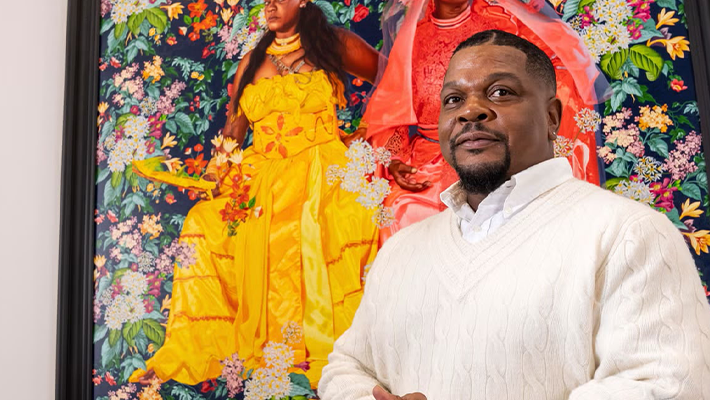
American painter Kehinde Wiley has formally requested that President Donald Trump allow him to repurchase a large painting that was removed from the U.S. Embassy in the Dominican Republic. The artwork, titled ‘Young Artists After Siamesas 1960,’ was part of the State Department’s Art in Embassies program and had been displayed prominently for nearly a decade before its removal.
Wiley’s Request and Background on Painting
Wiley submitted his request in a letter last week, addressed not only to President Trump but also to Leah Campos, the head of the Art in Embassies program, Erin Scavino, the current ambassador to the Dominican Republic, and U.S. Secretary of State Marco Rubio. In the letter, he stated, “If your administration has determined that it no longer wishes to display the work, I would like to ask for the opportunity to purchase it back.”
Reports indicate that the removal of the painting has been controversial. Scavino allegedly expressed concerns about the piece, which she called “aesthetically terrifying” during a podcast discussion. Campos had previously described the artwork, in Spanish, as featuring a picnic in a park with flowers and representations of queer individuals, including “lesbians.”
In a recent interview, Wiley expressed disappointment over the misunderstood perceptions of his work. He remarked, “If the administration is not particularly interested in the work, bring it home. Let me have it. It was a really successful painting, and it is a shame it was so little understood.”
Wiley also addressed the comments relating his work to a narrative about queer individuals, highlighting the broader implications of how such works are interpreted. “Was it homophobic? It’s possible… It says a lot about panic and fear,” he stated, reflecting on the potential biases that influence response to his art.
Wiley, who gained public attention for painting the official portrait of former President Barack Obama, underscored the significance of his work, emphasizing the effort and research he invested in creating the painting. He noted that he had spent two years studying the works of Dominican artists and collaborated with local art students for the final piece.
As of now, neither President Trump, the White House, nor the State Department has publicly responded to Wiley’s request regarding the painting’s repurchase.
Why It Matters
The incident underscores tensions surrounding art, representation, and political discourse, particularly as they relate to issues of identity and representation. Wiley’s experience reflects broader debates about the role of art in diplomatic spaces and how cultural products are valued or disregarded in political contexts.
