




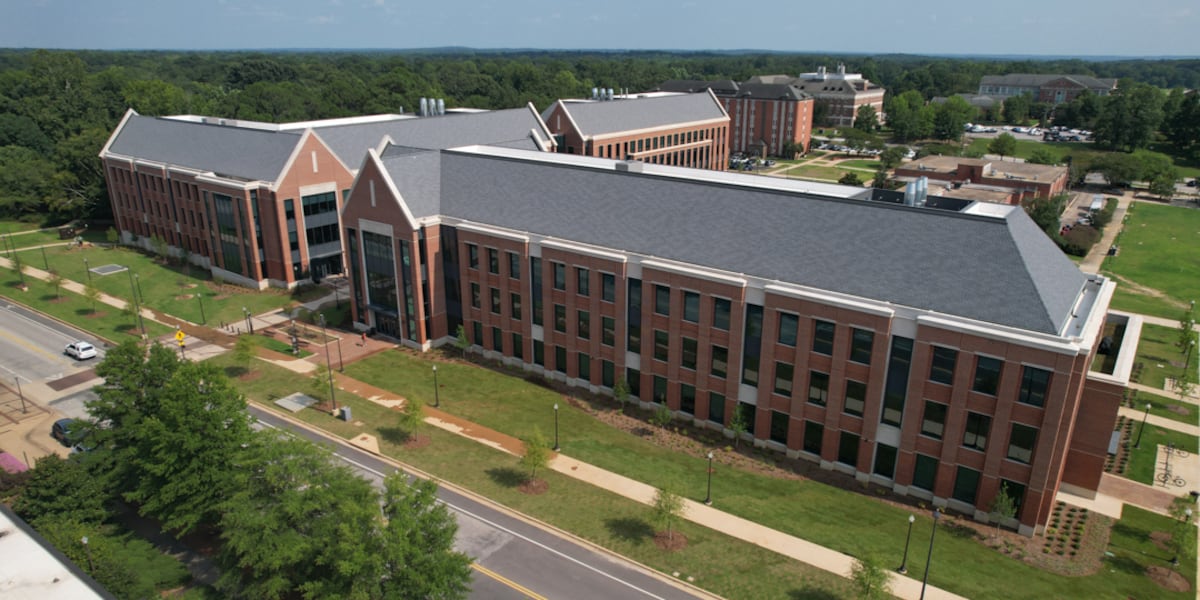
AUBURN, Ala. – Auburn University celebrated the grand opening of its $224 million STEM and Agricultural Science Complex on Friday, marking the completion of the largest research and education construction project in the university’s history.
The 265,000-square-foot facility has been utilized by agriculture and STEM students since the beginning of the fall semester, with the university announcing the project’s official completion following over six years of planning.
University leaders mark milestone
Arthur Appel, a representative at the ceremony, reflected on the evolution of the campus, stating, “In 1984, I was told that Funchess Hall was number 2 on the list to be replaced.” Christopher Roberts, another university leader, noted the significance of the complex, calling it “the largest research and education construction project in Auburn’s history” and emphasizing its role as a significant investment in the university’s future.
Edward Thomas added that the new facility will allow students to explore interdisciplinary connections, saying, “Students will have opportunities to see how their own disciplines connect with others, and how their work can contribute to something larger.”
Six departments merged under one complex
The complex combines six departments from Auburn’s College of Agriculture and the College of Science and Mathematics. The agricultural disciplines involved include Crop, Soil and Environmental Science; Entomology and Plant Pathology; and Horticulture. The STEM disciplines are Biological Sciences, Geosciences, and Mathematics and Statistics.
Appel highlighted the importance of collaboration in research, stating, “Breakthrough’s are not planned, they come through shared spaces where partnerships and creative collisions happen organically.” Roberts echoed this sentiment, remarking on how collaboration is crucial for advancement in areas like food security, environmental sustainability, and human health.
Funding and building design
The construction of the complex received $50 million in funding from the Alabama Public School and College Authority. The facility consists of three buildings connected by walkways above and below ground.
With nearly 70% of the complex allocated to teaching and research labs, more than 350 faculty members from various academic disciplines are now working within the new space. Thomas stated, “Those discoveries may begin in a laboratory, in a shared work space, or in a conversation between colleagues who once worked across campus from each other.”
