




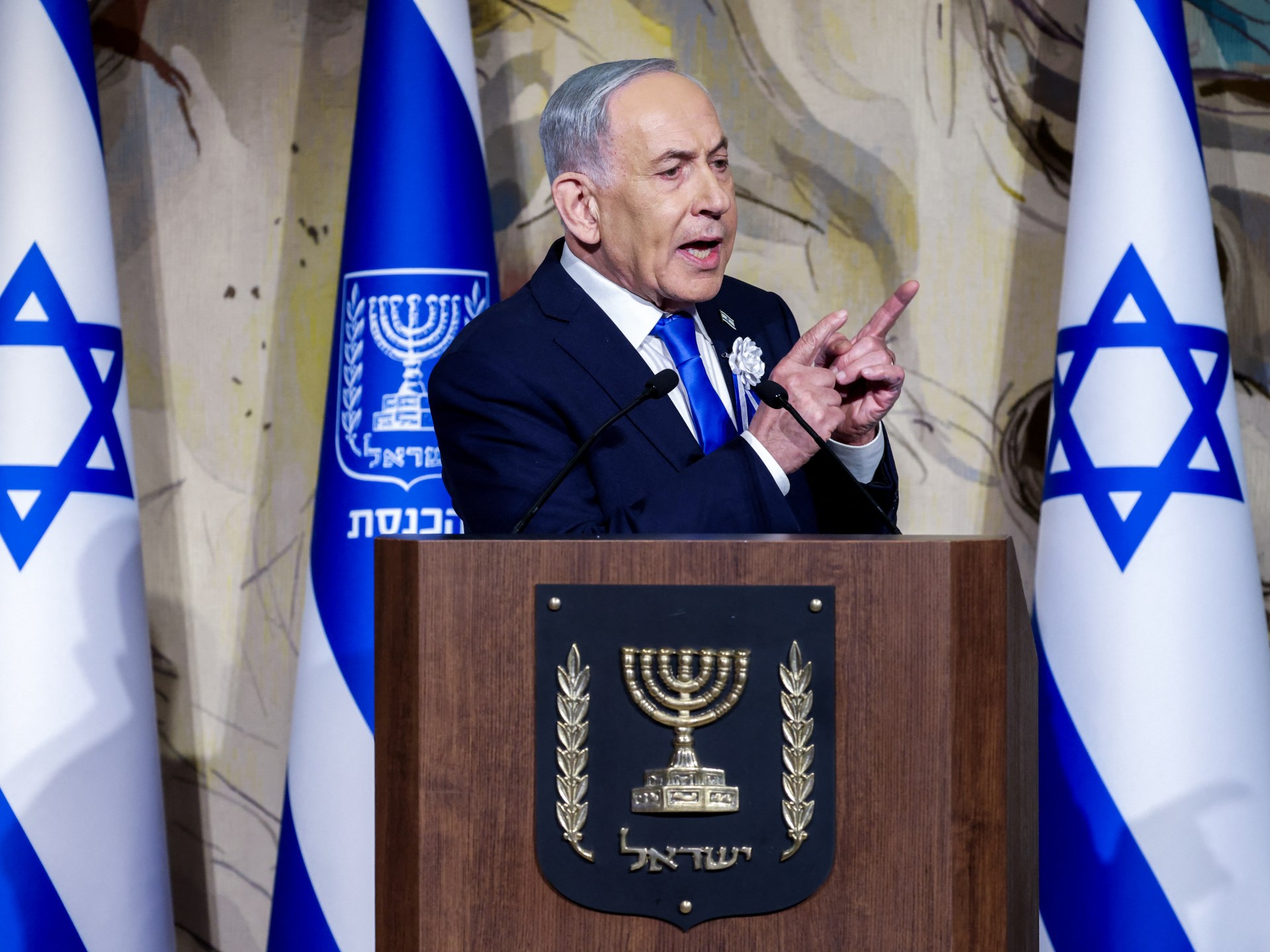
During the swearing-in of Israel’s new parliament, or Knesset, on Tuesday, Prime Minister Benjamin Netanyahu called for the formation of a national unity government aimed at Jewish Israelis, as he seeks to maintain his hold on power amid a growing opposition. The opposition, which now holds a majority of seats but has not yet formed a government, reacted to his remarks with heckling, catcalls, and walkouts.
Netanyahu highlighted the internal and external threats facing the country, referencing Iran and the increasing number of Palestinian lawmakers in the Knesset, whom he accused of seeking to undermine Israel, without providing evidence for his claims. He stressed the need for unity, stating, “We must do one thing – set aside every other consideration and form a national unity government,” emphasizing that only such a government could adequately address the country’s challenges.
He further criticized the possibility of a minority government, warning that it could include parties that he described as supportive of terrorism and antagonistic towards Israel. His remarks escalated tensions during the parliamentary session, which was marked by an unusually contentious atmosphere. Former Prime Minister Naftali Bennett heckled Netanyahu, while several Palestinian lawmakers whom Netanyahu targeted during his speech walked out in protest.
Gadi Eisenkot, who has been tasked with the first opportunity to form a new government, subsequently canceled coalition talks with Netanyahu and labeled him “unfit for office.”
Personality Politics
Netanyahu has significantly influenced Israeli politics, shifting it toward a system where personal loyalty often outweighs party affiliation. Despite his pivotal role in this transformation, he now faces the prospect of being sidelined if Eisenkot successfully forms a government. This outcome could leave Netanyahu vulnerable to his ongoing corruption trial and potential scrutiny regarding his government’s failures leading up to the October 7, 2023, Hamas-led attack.
His potential exit from the political arena may not end the trend of personality-driven politics in Israel. Roi Zur, a voting behavior specialist at the University of Essex, noted that Netanyahu has effectively made the Likud party a populist entity, leading voters to identify more with individual leaders rather than political parties. “When you ask people, ‘Who are you voting for?’, they say, ‘I vote for Netanyahu, I vote for Bennett, I vote for Eisenkot,’” Zur explained.
Dahlia Schneidlin, an American-Israeli pollster, pointed out that Israeli campaigns have increasingly centered on personal branding, despite the system being party slate-based. This shift has impacted the behavior of voters, who are often drawn more to personalities rather than party platforms. Nevertheless, forming a coalition usually requires leaders to exhibit strong negotiation and bargaining skills to align differing parties.
The emphasis on personal clashes over policy positions has fostered a political culture in which personal animosities, such as that between Netanyahu and opposition leader Avigdor Lieberman, complicate governance. Yossi Mekelberg from Chatham House cautioned that such a focus on the personal can create a toxic political environment, enabling unchecked actions by leadership. “With party structures so centralized, leaders can become almost dictatorial,” he said.
The future of Israel’s political landscape remains uncertain as coalition discussions progress and leaders navigate the complexities of a fragmented parliament.
