




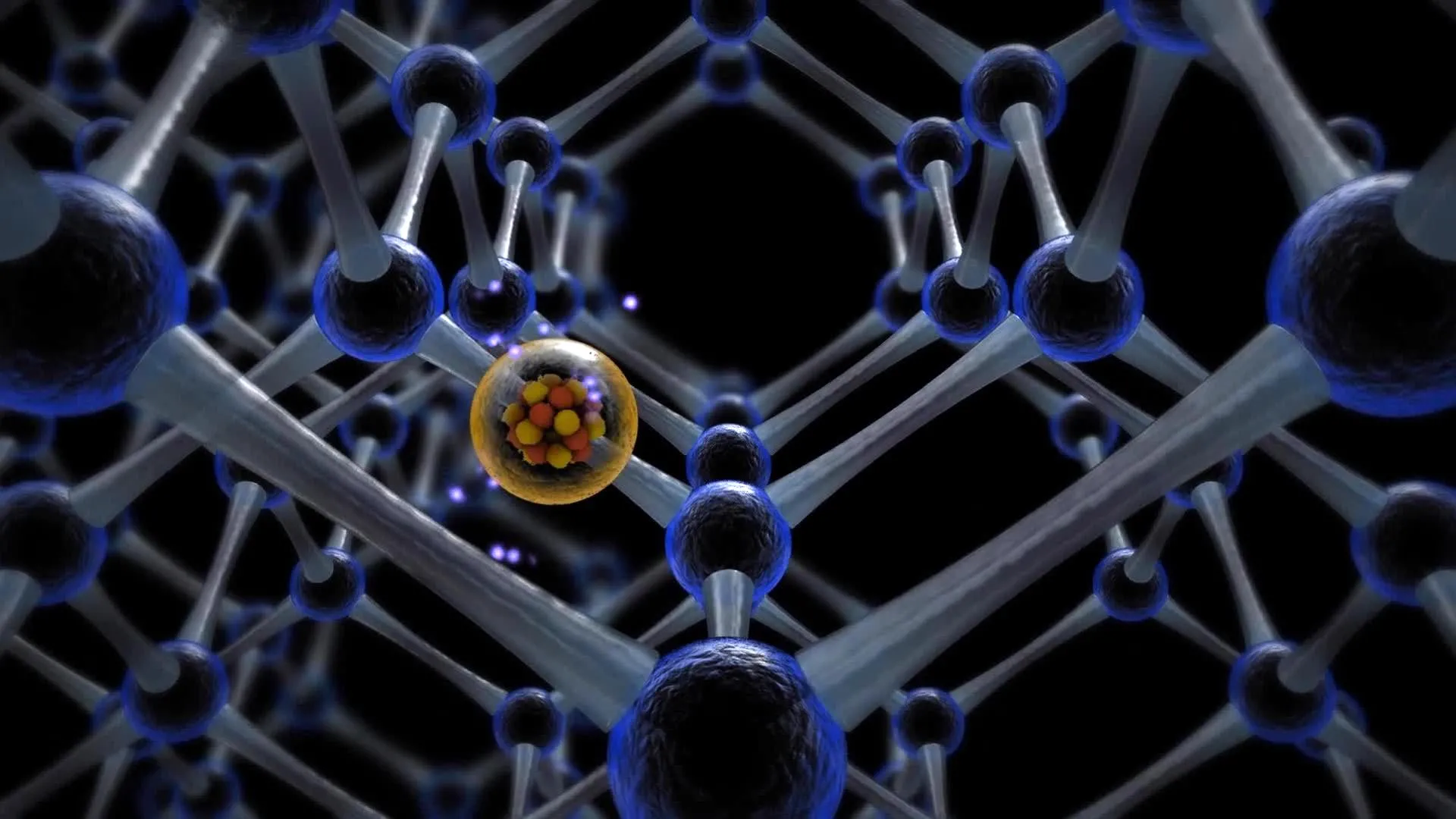
Researchers at the Harvard John A. Paulson School of Engineering and Applied Sciences (SEAS) have found a method to safeguard quantum information using mechanical vibrations, specifically microscopic sound waves. This development, led by graduate Eliza Cornell and former postdoctoral scholar Zhujing Xu under the guidance of Professor Marko Lončar, could advance the creation of compact quantum networks directly on chips.
Innovative Use of Phonons in Quantum Computing
The research, recently published in Nature Physics, explores the potential of using phonons, which are packets of mechanical vibrations, to transport quantum information. One approach involves leveraging the spin of an electron tied to an impurity in diamond to store quantum data. This method stands out as phonons can maneuver information among qubit nodes more effectively than light, typically used in quantum networking, due to their shorter wavelengths which allow for smaller components.
Phonons effortlessly interact with solid-state spins and electromagnetic fields, providing valuable opportunities for hybrid quantum systems that integrate various types of qubits within a unified framework. However, one significant hurdle when using phonons is the preservation of quantum memory, as qubits are sensitive to external interference and must maintain their quantum state for effective processing. Traditional methods that utilize microwave pulses to protect memories prove less effective for qubits in phononic cavities.
The SEAS team’s solution involves a novel approach termed “all-mechanical coherence protection.” Rather than relying on microwave pulses, researchers continuously applied a mechanical field generated by phonons to modify the quantum state of the spin in silicon-vacancy centers within diamonds, creating what is known as a “dressed” qubit. This term refers to the qubit’s interaction with a continuous acoustic field, which reduces its sensitivity to low-frequency environmental noise.
This technique allows phonons to play a dual role: they can transport quantum information while simultaneously protecting it from external disturbances. Cornell noted that this approach successfully handles two significant challenges: ensuring strong interactions with phonons while extending the qubit’s coherence time. The research achieved a threefold increase in coherence time for the silicon-vacancy spin, marking a significant advancement in maintaining quantum coherence using continuous mechanical noise suppression.
The study was supported by various U.S. federal agencies, including the National Science Foundation and the Air Force Office of Scientific Research, and was conducted in part at the Harvard Center for Nanoscale Systems. The Harvard Office of Technology Development is currently pursuing patent protection and commercialization for the innovations arising from this work.
Why It Matters
This research could play a pivotal role in enabling the development of reliable, compact quantum computing systems that leverage the advantages of phonons, potentially transforming future technologies in quantum networking and information processing.
