




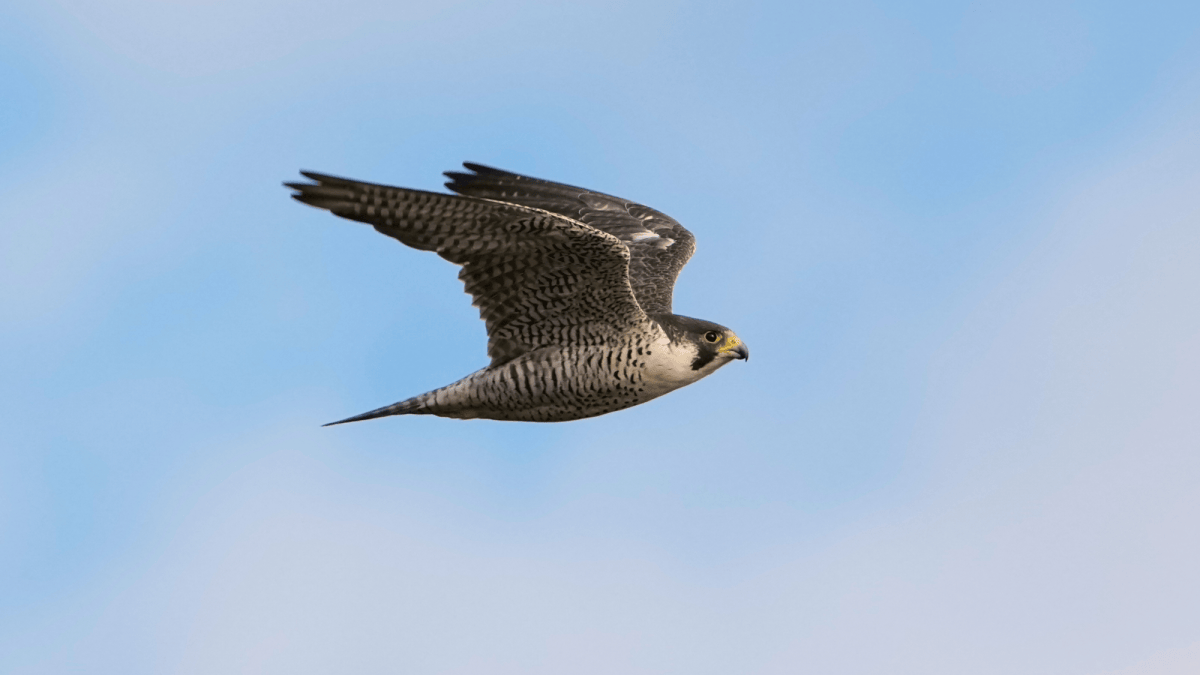
Research from the University of Nottingham indicates that peregrine falcons, known as the fastest animals on Earth, may benefit from climate change through an increased habitat in the United Kingdom. The study, led by researcher Connor Panter, appears in the journal Frontiers in Ecology and Evolution.
Panter’s research examined the potential impact of climate change on breeding habitats for various birds of prey, including peregrine falcons (Falco peregrinus). The analysis explored a “middle-of-the-road” climate change scenario and a “worst-case” scenario for the UK future. Currently, there are 42,570 square miles of suitable habitat for peregrine falcons.
Under the middle-of-the-road scenario, suitable habitat could increase by 40.6 percent by 2060. The worst-case scenario indicates a more significant increase, with suitable habitats potentially rising by 73.5 percent by the year 2080.
Other species such as hen harriers (Circus cyaneus), golden eagles (Aquila chrysaetos), little owls (Athene noctua), and long-eared owls (Asio otus) may also see increases in their suitable habitats. However, common buzzards (Buteo buteo), European sparrowhawks (Accipiter nisus), and tawny owls (Strix aluco) are not expected to experience significant habitat changes.
Peregrine falcons are not alone in this scenario; some species, like British short-eared owls (Asio flammeus), red kites (Milvus milvus), merlins (Falco columbarius), and Eurasian goshawks (Astur gentilis), are likely to lose substantial habitat as a result of climate changes.
Panter emphasized that the impact of climate change on wildlife varies among species. “We know that climate change is altering where wildlife is found across the world, but scientists’ understanding of how different birds of prey may respond to these changes is still relatively limited,” he stated. He noted that the growth of suitable habitats does not guarantee increased populations or broader distributions for these species, as factors such as prey availability and human threats will also play critical roles.
Moving forward, conservation strategies will need to address these differences in response to habitat changes, according to Panter. “It is crucial to recognize that an increase in suitable area does not necessarily lead to a population increase,” he remarked.
