




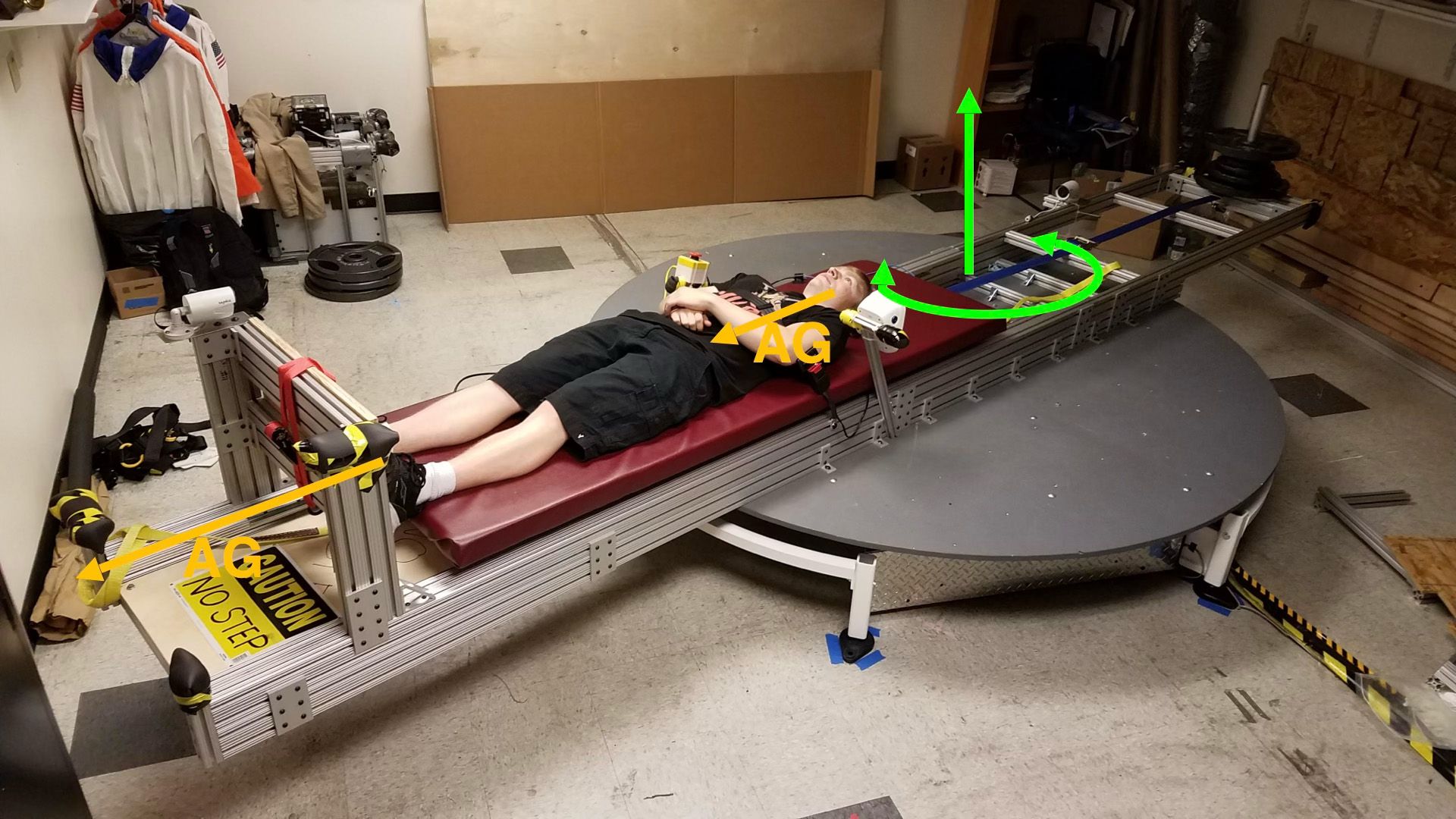
Artificial gravity has emerged as a potential solution to mitigate negative health effects faced by astronauts during prolonged missions in microgravity. Experts indicate that living in low-gravity environments can lead to significant health issues, such as vision deterioration, bone density loss, and muscle atrophy.
Exploring the Feasibility of Artificial Gravity in Space
Creating artificial gravity aboard spacecraft is not a novel concept; it has been a topic of discussion spanning decades. Scientists and engineers are exploring various methods to produce forces akin to Earth’s gravity in space. Torin Clark, an associate professor of aerospace engineering at the University of Colorado Boulder, stated that technological advancements have progressed to a point where creating artificial gravity could be feasible in the near future.
Previously, the Centrifuge Accommodation Module was proposed as an 8.2-foot-wide centrifuge for the International Space Station (ISS), designed to generate artificial gravity. However, the project was canceled in 2005 due to financial constraints. Ana Diaz Artiles, an associate professor of aerospace engineering at Texas A&M University, remarked on the cyclical nature of artificial gravity projects, highlighting that despite its theoretical benefits, implementations often fall victim to funding and logistical challenges.
Three primary approaches exist for generating artificial gravity. The first involves a giant rotating ring that would spin entire living quarters, allowing astronauts to reside under simulated Earth-like gravity. This method, while effective, requires substantial resources and planning for construction in orbit.
The second option is a short-radius centrifuge that would enable astronauts to experience gravity in controlled sessions. Such a centrifuge would effectively simulate gravity by spinning at high speeds, albeit the rapid rotation could cause motion sickness related to the Coriolis effect. Recent research indicates that individuals can acclimatize to these sensations through gradual exposure.
The third method entails using linear acceleration, whereby the spacecraft would continuously accelerate to replicate the effects of gravity on its occupants. However, the current state of propulsion technology presents significant challenges with this approach.
While a short-radius centrifuge stands out for its practicality and engineering viability, questions remain about its optimal operational parameters. Research shows that even limited exposure to simulated gravity can combat some effects of microgravity, yet precise measurements of duration and intensity remain undefined. Clark and Artiles emphasize that determining the necessary gravity levels and durations requires extensive further study.
In summary, the challenge of implementing artificial gravity in space is one of understanding and funding rather than the absence of technology. Both Clark and Artiles assert that significant advancements are achievable with the right support and research into optimal usage durations and effects.
Why It Matters: As human space exploration expands, developing solutions to negative health outcomes in microgravity is crucial for the long-term viability of missions to Mars and beyond. A viable artificial gravity system could enhance astronaut health and performance, ultimately leading to successful, extended interstellar missions.
