




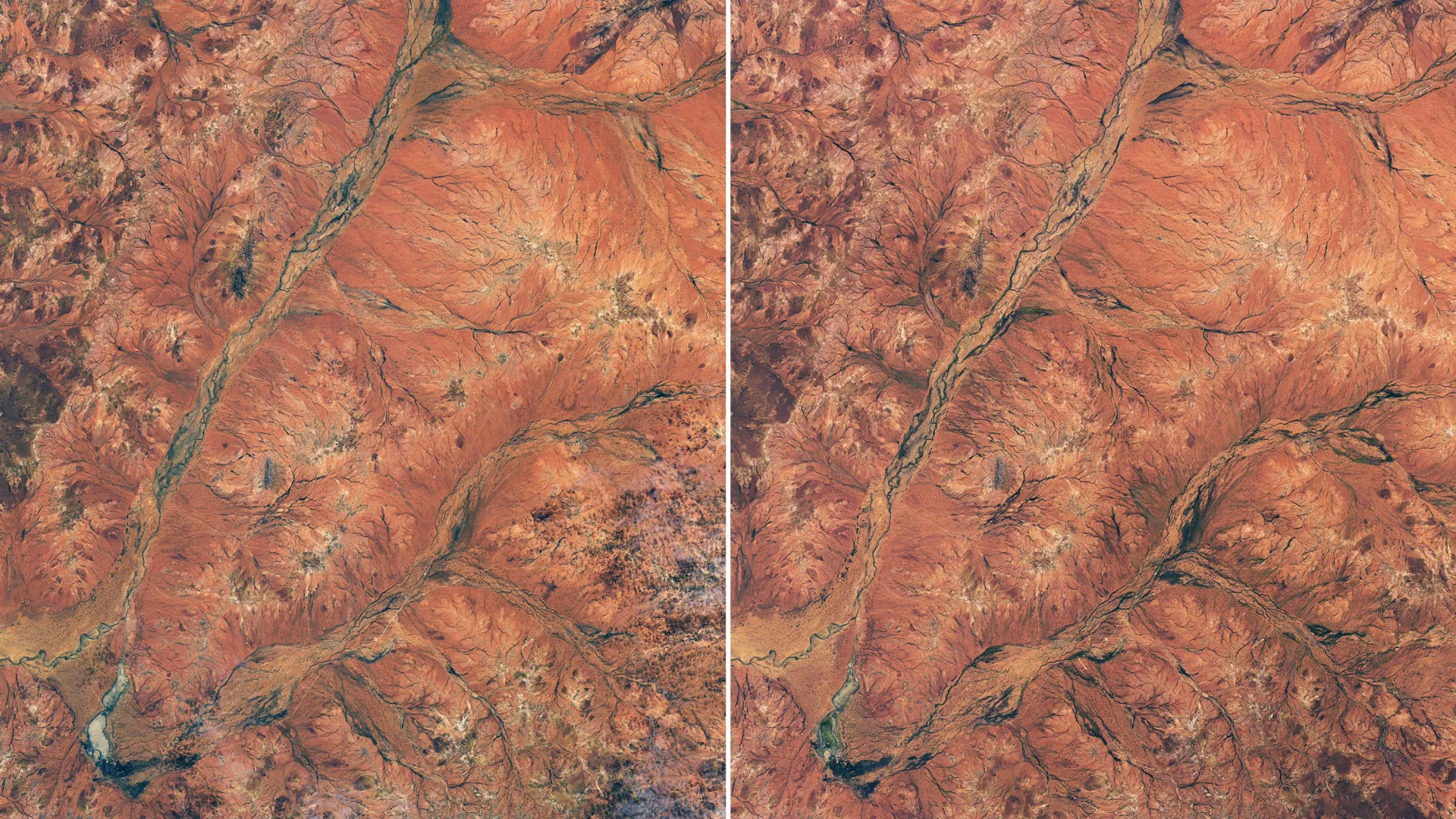
A spectacular explosion of wildflowers has transformed the dry, rust-colored landscape of Western Australia into a colorful display, following months of unusually wet weather that awakened dormant seeds. By late winter 2026 in the Southern Hemisphere, large areas of the region’s arid shrubland experienced a floral bloom that local experts believe could be the most impressive seen in nearly two decades.
Nasa’s satellite imagery highlights the dramatic change in the landscape over a single year. Images captured by the Operational Land Imager aboard the NASA-USGS Landsat 8 satellite show the same area in the Murchison region, approximately 600 kilometers (370 miles) north of Perth, during late August 2025 and late August 2026. The imagery illustrates a stark increase in vegetation attributed to the exceptionally wet conditions.
The Murchison region, a vital grazing area for sheep and cattle, typically features hardy plants well-adapted to dry conditions. The local vegetation primarily consists of grasses, saltbush, and mulga, an evergreen tree resilient to limited rainfall. While wildflowers do surface periodically, their frequency hinges significantly on rainfall levels.
The wildflower explosion witnessed in 2026 was fueled by a series of cold fronts that delivered necessary moisture to the area. According to the Bureau of Meteorology, June experienced above-average rainfall, while August proved to be much wetter than normal. These conditions permitted long-dormant seeds to germinate, resulting in an extraordinary variety of wildflowers across the terrain.
This vibrant transformation extended onto the grounds of the CSIRO (Commonwealth Scientific and Industrial Research Organisation) Murchison Radio-astronomy Observatory. Amidst the colorful blooms were several threatened plant species, enhancing the ecological importance of the seasonal display. The observatory has been instrumental in monitoring these vulnerable plants on lands that were previously utilized for livestock grazing.
The CSIRO Murchison Radio-astronomy Observatory focuses on studying the universe through radio astronomy, employing antenna arrays to detect radio signals from celestial objects. Its remote location within a designated “radio quiet” zone is crucial for minimizing interference from communication systems, which allows astronomers to capture faint emissions from space.
Australia’s radio astronomy facilities boast a legacy of supporting significant NASA missions. The Murriyang radio telescope in New South Wales aided in tracking the Mariner 2 spacecraft in 1962 and played a pivotal role in communications during the Apollo 11 Moon landing in 1969. Moreover, the CSIRO oversees the Canberra Deep Space Communication Complex, one of three major facilities within NASA’s global Deep Space Network that maintains spacecraft communications throughout the solar system.
In April 2026, both the Murriyang telescope and the Canberra complex contributed to NASA’s Artemis II mission, continuing Australia’s long-standing partnership in space exploration. Amidst this backdrop of significant astronomical research, the remarkable wildflower spectacle in the Murchison region offered a vivid contrast, showcasing the area’s natural beauty while its telescopes continued to explore the universe.
