




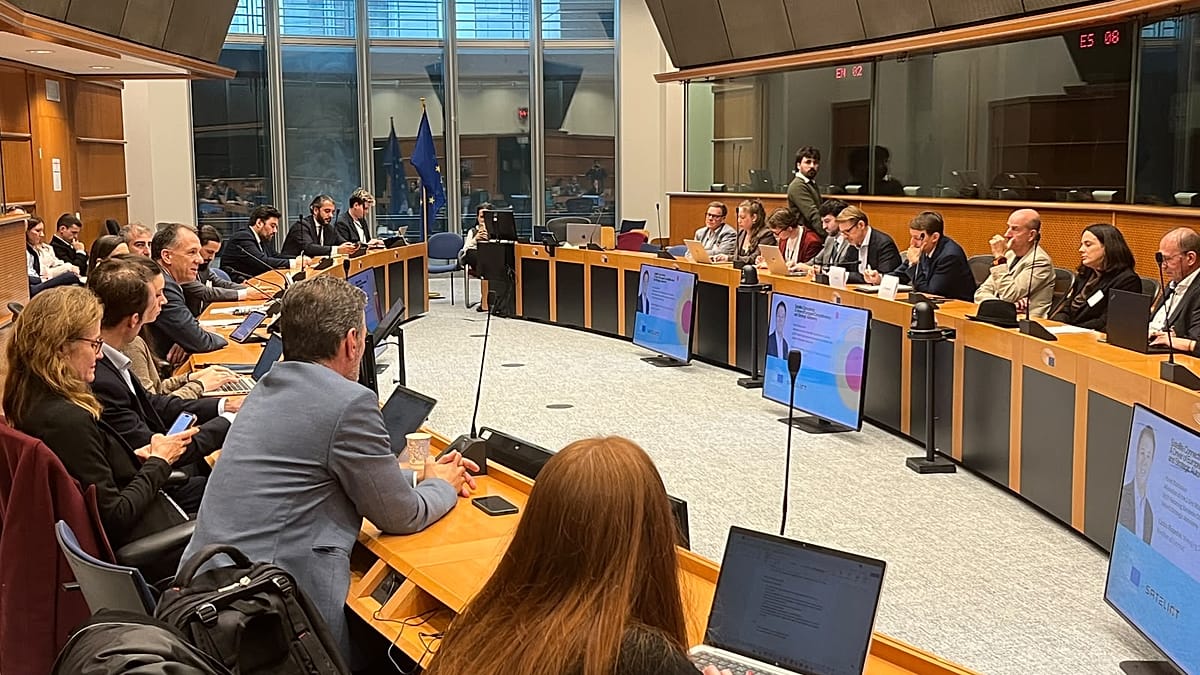
National telecom authorities, EU policymakers, and Barcelona-based satellite company Sateliot convened at the European Parliament in Brussels on Tuesday to discuss the pivotal roles of radio frequencies and funding in determining control over Europe’s satellite communications. This meeting comes as the European Union approaches the expiration of its seven-year space budget in 2027.
Sateliot, known for its spacecraft that function as mobile phone masts in space, facilitates connectivity for Internet of Things (IoT) devices like sensors and trackers in areas beyond the reach of traditional ground networks. The EU’s €14.8 billion space program, covering the 2021-2027 period which includes funding for the Galileo satellite navigation system and Copernicus Earth observation service, is set to conclude next year along with the Multiannual Financial Framework (MFF).
Looking ahead to 2028-2034, the European Commission is advocating for a new European Competitiveness Fund aimed at strategic industries, which would allocate €131 billion for both defence and space initiatives. EU leaders are scheduled to deliberate on the upcoming budget during the European Council meeting later this week.
The Commission’s Directorate-General for Defence Industry and Space (DG DEFIS) recently closed bids on September 29 for a €55 million, four-year contract intended to provide management and legal support for critical initiatives including the IRIS² secure satellite constellation and space surveillance efforts.
Spectrum and Sovereignty
A key topic at the gathering was the management of spectrum, essential for satellite and mobile network communication. In May, the Commission proposed a unified EU-wide license for mobile satellite services in the 2 GHz band. This proposal aims to reserve a portion of the band specifically for European operators and will support secure connections linked to the IRIS² project.
The meeting was hosted by European Parliament Vice-President Javier López, with representation from the Commission’s digital department, led by Gerasimos Sofianatos. López emphasized the urgency of achieving technological independence, stating, “A Europe that controls its own network and data is a Europe that can act independently and make its own decisions.”
After the meeting, Jaume Sanpera, CEO of Sateliot, stressed the importance of cultivating European companies capable of competing globally in the space sector. He remarked, “Today, half the world wants to work with European companies in defence and space because we are more predictable.”
In a recent development, the European Space Agency (ESA) selected Sateliot to contribute to IRIS²’s Low-LEO layer, designed as a testing platform for new government services before they are integrated into the main system. The ESA plans in-orbit test missions from 2027 to 2029.
On October 1, Sateliot successfully launched five satellites with the support of SpaceX, bringing its total launched satellites to 11. This additional capacity aims to enhance connectivity, providing double the daily coverage over specific locations.
Looking to the future, Sanpera expressed optimism about developing European launch capabilities, noting several domestic companies are gearing up to fill this gap. Sateliot’s next scheduled launch in July 2027 will utilize SpaceX, followed by a mid-2028 launch with Spanish company PLD Space. This forthcoming mission will mark a milestone by employing completely European technology to deploy Sateliot’s new-generation Tritó satellites, aimed at offering direct 5G services.
As Sateliot continues to expand, it aims to raise €150 million from investors to bolster its satellite constellation to over 500 units by 2028.
