




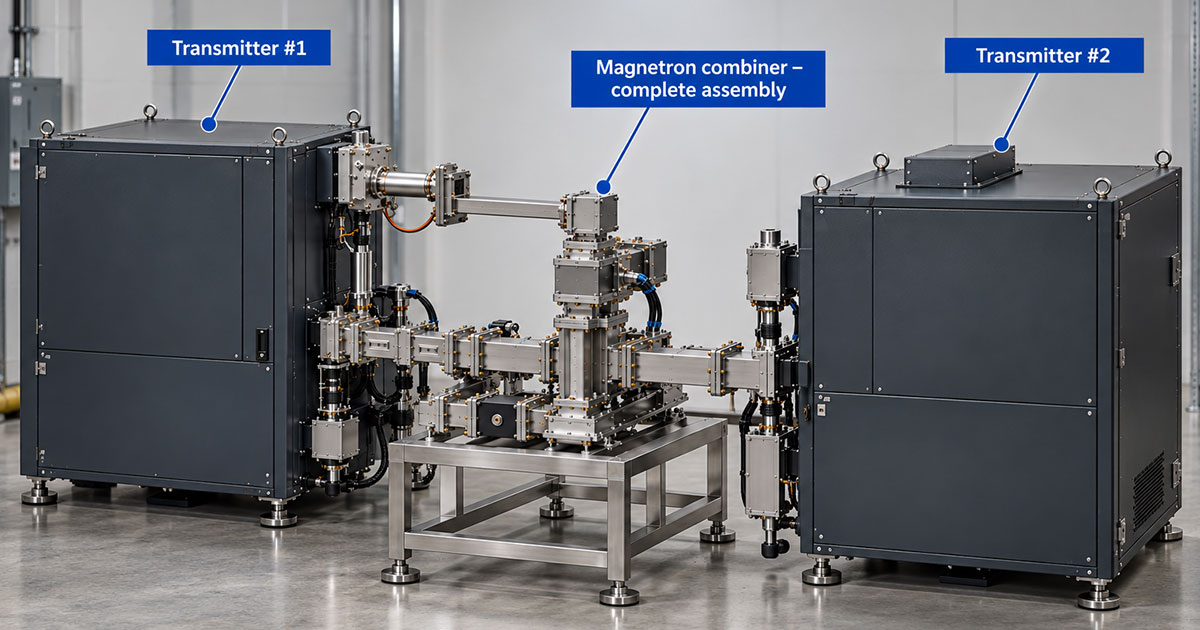
San Diego, CA — October 21, 2026 — General Atomics (GA) has taken a leading role in a collaborative initiative aimed at addressing the complex issue of nuclear waste in the United States. The project, known as NEWTON (Nuclear Energy Waste Transmutation Optimized Now), focuses on developing new technology to make the processing of used nuclear fuel more efficient and cost-effective.
Led by the U.S. Department of Energy’s Advanced Research Projects Agency-Energy (ARPA-E), the NEWTON program includes partnerships with Jefferson Lab, Stellant Systems, and Oak Ridge National Laboratory. General Atomics has been awarded a contract to create a prototype radio frequency (RF) system utilizing magnetron combining technology. This innovation seeks to enhance the methods used in nuclear waste transmutation, which aims to convert used nuclear fuel into more manageable forms.
Dr. Drew Packard, a scientist at General Atomics Energy, expressed pride in the project’s potential, stating, “Our team combines cutting-edge scientific and industrial expertise to deliver key technology that could help advance future transmutation systems toward practical, large-scale operation.”
According to the U.S. Department of Energy, the nation has accumulated over 90,000 metric tons of used nuclear fuel, generating approximately 2,000 metric tons each year. A substantial portion remains in storage at nuclear power plants across the country. While countries like France recycle usable materials from spent fuel, the U.S. faces challenges such as high costs and significant government investments that have hindered commercial recycling efforts.
The NEWTON initiative posits that transmutation technology could help mitigate these obstacles. Transmutation involves using particle accelerators to direct high-energy particles at hazardous materials in used nuclear fuel, effectively altering them into forms that pose less danger over shorter timeframes. However, scaling this process up has been limited by the substantial electricity consumption of these accelerators.
To address this, General Atomics and its partners will design a new RF system harnessing multiple magnetrons to generate concentrated microwave energy. This development aims to reduce the electrical demands and costs associated with operating particle accelerators.
Conner Prochaska, director of ARPA-E, remarked, “This project is President Trump’s nuclear renaissance in action, putting the same basic technology behind a kitchen microwave to work on one of nuclear energy’s toughest challenges, spent fuel.” He emphasized that smaller, more efficient accelerators could lessen the long-term impact of nuclear waste and enhance American leadership in nuclear innovation.
With a history of advancing nuclear technology since the 1950s, General Atomics is well-versed in complex systems, having contributed to various major projects such as the ITER Central Solenoid and the DIII-D National Fusion Facility. If successful, the new magnetron combiner could integrate into larger accelerator systems, paving the way for further advancements in transmutation technology.
Beyond addressing nuclear waste, more efficient accelerators may also benefit other fields, including medical isotope production and the remediation of environmental contaminants like PFAS. Packard highlighted the importance of collaboration between industry and national laboratories, stating, “This project brings together the strengths of American industry and the national laboratory community to address a persistent challenge that demands new technical solutions.”
For further details about the NEWTON program, visit ARPA-E’s NEWTON program page. Additional information about General Atomics can be found on GA’s Energy Systems and Products page.
About General Atomics
General Atomics has been at the forefront of scientific and technological advancement since the onset of the atomic age, contributing significantly to fields including nuclear energy, medicine, defense, and high-performance computing.
