




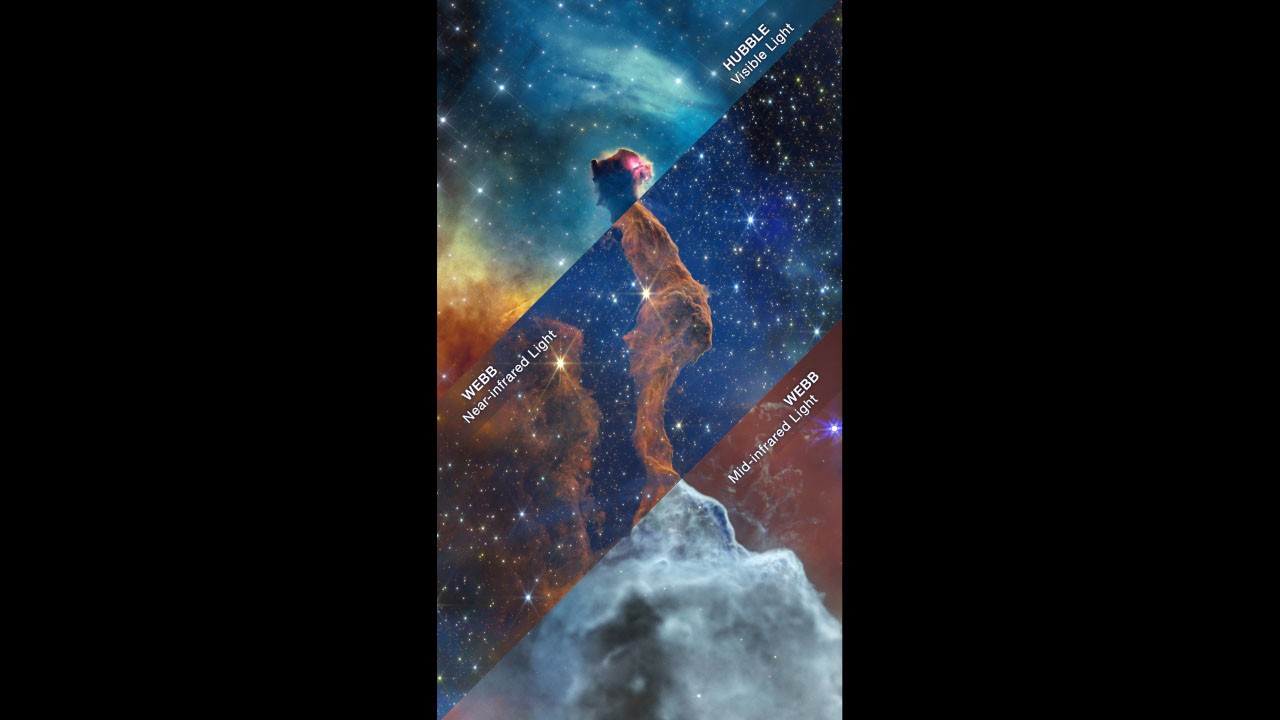
NASA’s Hubble and James Webb Space Telescopes have provided new insights into the Cat’s Head Nebula, a small, dusty formation within the larger Carina Nebula that is currently home to forming stars.
The data from the two telescopes highlights the distinct characteristics of the nebula. Hubble’s visible-light imagery captures the cat-shaped filament in dark brown, set against a vibrant gas background. An ionization front observable on the right side of the figure indicates areas where the surrounding dust is being heated and evaporated.
In contrast, the James Webb Space Telescope uses infrared light to reveal features not visible to Hubble. Webb’s mid-infrared images show faint dust pillars, while its near-infrared views allow scientists to see through some of the dust, uncovering numerous stars not detectable in visible light. A bright point known as the cat’s eye, believed to be a young star embedded in the dust, is prominent in all images.
While the Cat’s Head Nebula is a fleeting phenomenon that will eventually disperse, the observations from Hubble and Webb are advancing our understanding of the complex processes involved in star formation. These findings are expected to contribute to ongoing research in astrophysics.
