




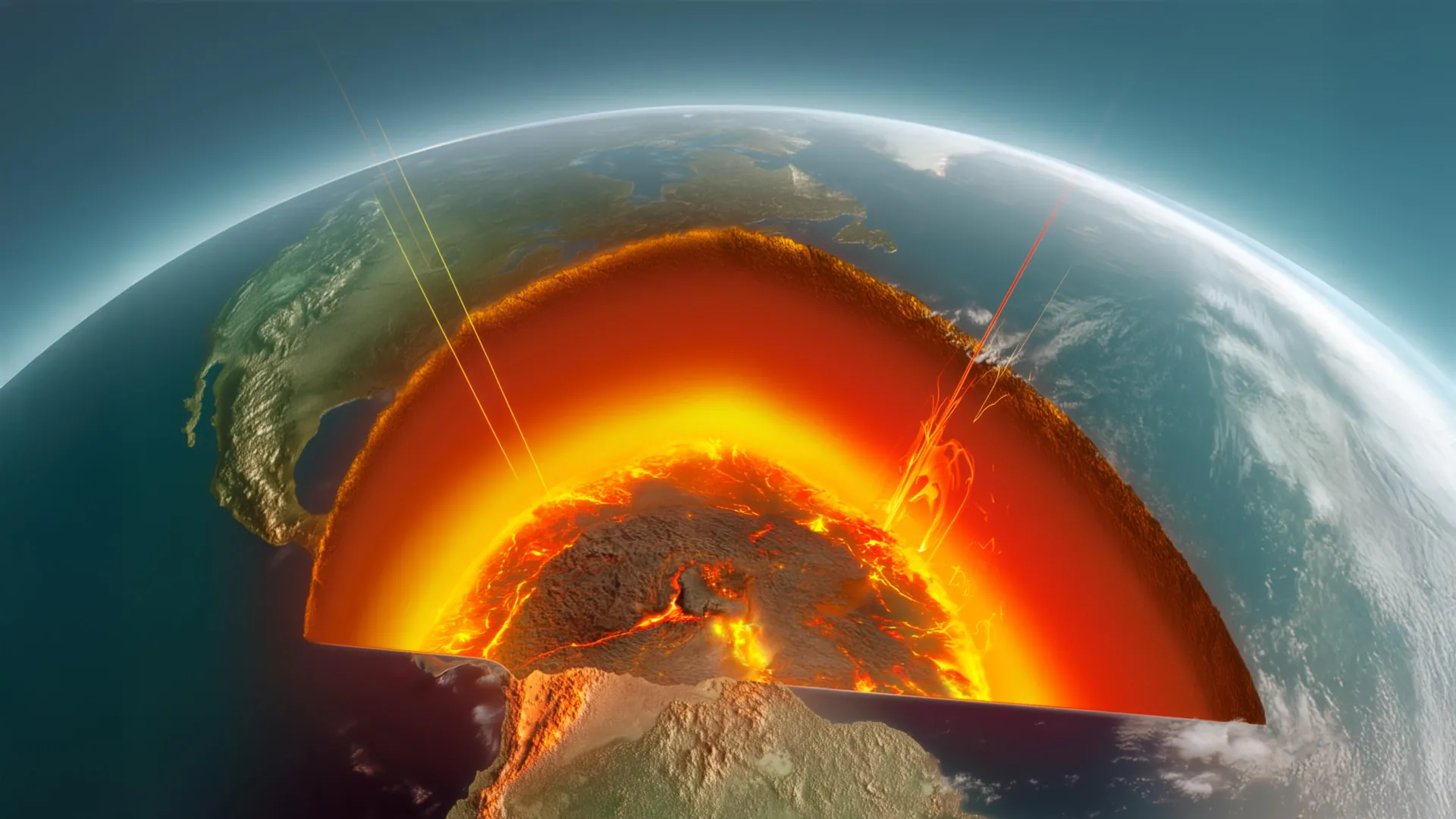
Scientists have revealed that molten rock deep within Earth can store significantly more oxygen than previously understood, a finding that may alter long-held beliefs about magma and its role in shaping the planet’s atmosphere billions of years ago. The study led by Dr. Yanhao Lin and Dr. Ho-kwang Mao from the Center for High Pressure Science and Technology Advanced Research (HPSTAR), alongside collaborators from Northwestern Polytechnical University and Vrije Universiteit Amsterdam, has been published in the journal National Science Review.
Through a combination of high-pressure laboratory experiments and advanced computer simulations, the researchers demonstrated that magma can absorb additional oxygen beyond its chemical requirements. This previously unrecognized reservoir of oxygen may link Earth’s deep interior, volcanic activity, and the evolution of its oxygen-rich atmosphere.
Oxygen is one of the most abundant elements in Earth’s interior, primarily found in silicate minerals that constitute much of the mantle and crust. Traditionally, scientists believed that magma could only retain a limited amount of oxygen based on the other elements present, including silicon, magnesium, and iron. However, volatile components such as water and carbon dioxide have been known to dissolve in magma, escaping as gases when pressure decreases. In contrast, oxygen has not been viewed as an independent volatile constituent that could be absorbed and released by magma.
The researchers utilized specialized laboratory equipment to simulate extreme conditions found deep within Earth. They heated a synthetic form of mid-ocean ridge basalt and applied pressures ranging from normal atmospheric levels to 7 gigapascals—about 69,000 times atmospheric pressure—and temperatures between 1200 and 1800 °C. Under these conditions, they introduced platinum oxide to create an oxygen-rich environment, further investigating the potential for additional oxygen absorption in the molten rock.
The experiments revealed a notable correlation between pressure and the capacity of the magma to store excess oxygen. While glass samples taken at normal atmospheric pressure showed minimal excess oxygen, those subjected to 7 gigapascals contained over 5% excess oxygen by weight. In comparison, runs without platinum oxide yielded only 0.2% to 0.5% excess oxygen.
To confirm that the added oxygen was genuinely integrated into the material and not trapped as gas bubbles, the team employed Raman spectroscopy, which indicated no signs of oxygen gas, confirming its incorporation into the glass structure.
Additionally, computer simulations led by Prof. Haiyang Niu demonstrated that oxygen could dissolve in molten rock until reaching an equilibrium state. Although the models used simplified systems, they echoed the laboratory findings, showing that magma’s ability to store excess oxygen increases under pressure.
This discovery raises questions about Earth’s geological past and whether magma could have transported significant amounts of oxygen from the interior to the surface. Researchers propose that magma generated in oxidized areas of the mantle may have absorbed excess oxygen. As it rises, decreasing pressure could lead to the release of that oxygen, possibly influencing the oxidation processes of the mantle, crust, and atmosphere.
The findings provoke speculation about the role of ancient volcanic activity in the rise of atmospheric oxygen levels between 2.5 billion and 2 billion years ago, coinciding with the formation of large igneous provinces. Preliminary calculations suggest that even a small release of oxygen from massive amounts of magma during this time could match the current volume of oxygen in Earth’s atmosphere.
This research could reshape understanding in areas related to planetary science, including the dynamics of ancient magma oceans and volcanic degassing. Acknowledging that magma can operate independently in oxygen storage may be crucial for future models of atmospheric evolution, potentially offering insights into the development of habitable environments on rocky planets.
