




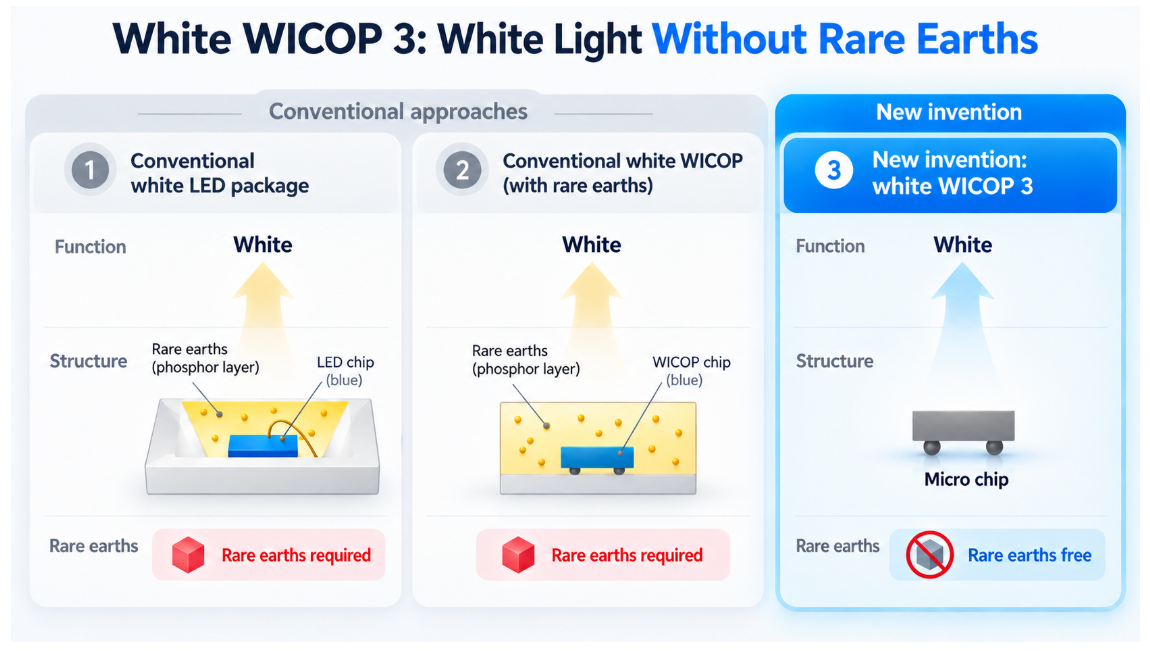
Seoul Semiconductor has advanced its WICOP (Wafer Integrated Chip on PCB) technology, an opto-semiconductor innovation that eliminates conventional packaging to enhance design flexibility and device miniaturization. This evolution spans three generations: WICOP 1, which launched in 2018 with package-free structures; WICOP 2, focusing on lens-free designs and high-voltage operations; and the latest, WICOP 3, which generates white light without using rare-earth phosphors.
The development of WICOP technology arose amid fierce competition in the global LED market during the 2010s, with a significant influx of manufacturers. Chung Hoon Lee, the founder of Seoul Semiconductor, emphasized the need for distinctive technology to ensure sustainable growth beyond mere price competition. Committed to innovation, he invested around $100 million annually in research and development, even in challenging economic times.
WICOP 1 marked a significant milestone by questioning the necessity of semiconductor packaging, traditionally vital for protecting chips from environmental factors while maintaining stability and electrical connections. The introduction of this technology allowed for smaller chip designs and paved the way for advanced Micro LED applications, with ongoing collaborations with the University of California, Santa Barbara, to further refine these innovations.
The second generation, WICOP 2, emerged by challenging the need for lenses in controlling light distribution and the conventional operating voltage of LED chips. It introduced high-voltage semiconductor solutions capable of operating at 12V or 24V, which simplifies system designs and enhances efficiency, crucial for applications in electric and hybrid vehicles. Notably, this technology is supplied to automotive manufacturers, including Tesla.
WICOP 3 further pushes boundaries by eliminating the reliance on rare-earth elements, which are often used in phosphor materials for white light generation. This development aims to address vulnerabilities in the global supply chain for rare earths, reducing geopolitical risks. The new generation combines the principles of package-free design with a novel approach to producing white light, setting the stage for further advancements in compact opto-semiconductor applications.
Seoul Semiconductor and Seoul Viosys are now preparing for the mass production of WICOP 3 technology, which promises to elevate possibilities for various fields, including automotive lighting and miniature display systems. As the companies continue their innovative journey, they remain focused on expanding the horizons of opto-semiconductor technology.
