




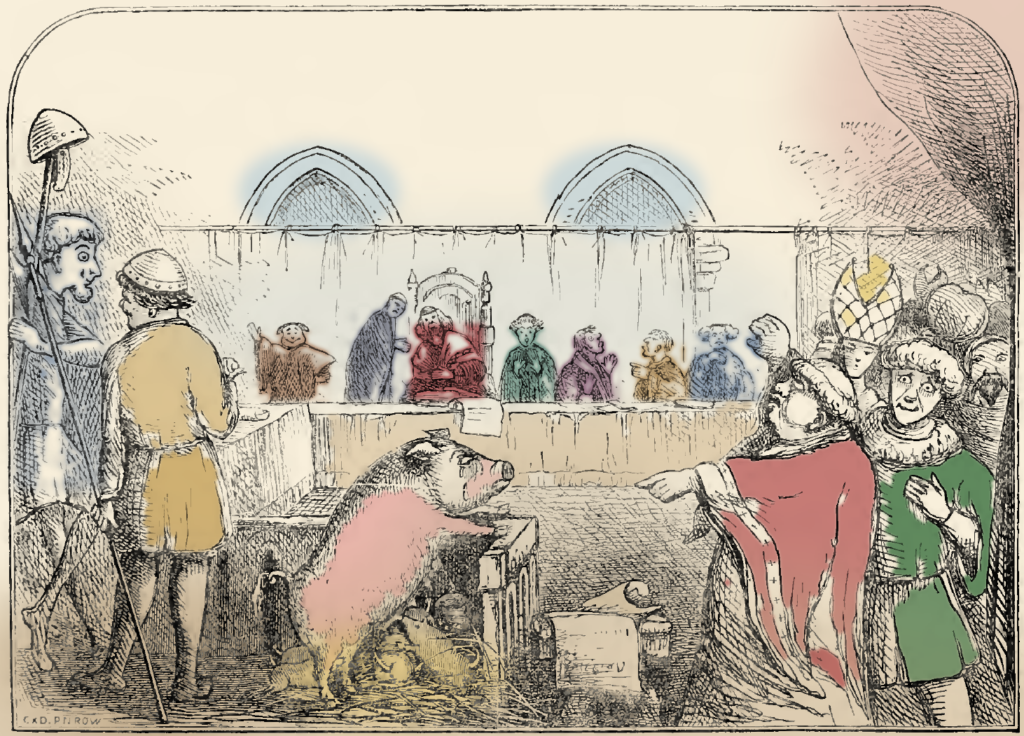
Between the tenth and eighteenth centuries, particularly during the fifteenth and sixteenth centuries, animals accused of causing harm to humans were sometimes put on trial in medieval Europe. Notable instances include the earliest recorded pig trial in Fontenay-aux-Roses, near Paris, in 1266. By the early fifteenth century, such trials had become a legal practice across regions including Normandy and Île-de-France, eventually spreading to Italy, Germany, and the Low Countries.
During this era, animals were often held accountable for violent acts against humans, such as attacks by horses, bulls, and notably, pigs. Unlike today’s perspective, where the killing of a child would be viewed as an inhumane act, medieval society sometimes sought justice through legal recourse against the animals accused of such offenses. The outcome typically involved the animals being tried in local courts rather than being summarily executed.
Historian Alexander Lee notes that the application of Roman law, which stated that animals could not be culpable due to their lack of reason and criminal intent, contrasted with local customs in northern France where animals faced legal proceedings. This legal framework allowed the trials to serve purposes beyond simple punishment. University of Liverpool expert Damian Kempf explains that for medieval people, trying and executing a pig, for example, could be seen as a means to restore divine order.
While domestic animals like pigs faced court trials, vermin such as mice, beetles, and snails were adjudicated in ecclesiastical courts. According to Sonya Vatomsky of JSTOR Daily, these creatures would be excommunicated rather than executed, as this condemnation enabled humans to eliminate them from their environment with a clear conscience. Furthermore, economist Peter T. Leeson suggested that during periods of declining tithing, the Catholic Church increased the prosecution of animals to reinforce the validity of Church punishments among citizens.
The practice of putting animals on trial reflects the cultural beliefs of medieval society and invites reflection on contemporary views regarding animal rights. Although the notion may seem grotesque today, it highlights the historical context in which people operated, prompting questions about the evolution of societal attitudes toward animals.
