




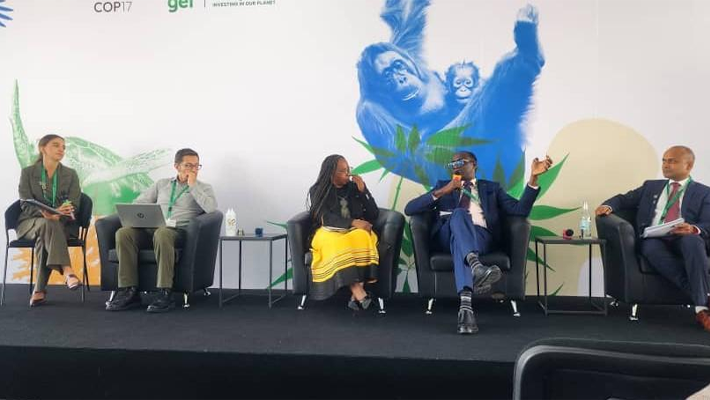
The African Green Economy and Sustainability Institute (AGESI) has emphasized the urgent need for decision literacy on the continent to effectively access nature finance.
Eugene Itua, the executive director of AGESI, made this statement during a side event at COP17 titled “Blended Finance for Nature: From Policy Coherence to Investment.” The event was held at the Global Environment Facility (GEF) Pavilion in Yerevan, Armenia, on Friday.
“Africa needs decision literacy, not more plans, to unlock nature finance,” Itua said.
He criticized the current structure of African institutions, noting they are often designed for short-term revenue rather than focusing on long-term natural capital value. Itua asserted that the primary gap in capacity across Africa is not technical knowledge but rather the ability to convert nature priorities into viable financial decisions.
To bridge this gap, he highlighted that ministries, regulators, and development finance institutions require practical tools that address three key questions: the economic value at risk if nature fails, the potential financial return, and how to create incentives that benefit local communities.
Itua presented two approaches aimed at enhancing understanding of nature finance: a nature-positive decision system and the FIPRE framework. These initiatives assess whether proposals contribute meaningfully to ecosystem function, measurable impact, prosperity, resilience, and equitable benefits. He explained that these systems help budget officers, bankers, and governments comprehend and approve funding decisions.
The necessity for policy coherence, fiscal reforms, risk-reduction instruments, and the practice of nature capital accounting was also emphasized. Itua cautioned that, in Nigeria, existing economic incentives tend to favor depletion over restoration.
He detailed the Business and Biodiversity Action Plan implemented through the Business Advisory Group (BAG), which aims to translate national priorities into corporate investments, disclosures, and supply-chain decisions.
Itua warned that if Africa does not develop its own natural capital standards, it risks having to adopt frameworks created for non-African ecosystems. He described the creation of these standards as a strategic economic necessity, asserting that aligning policies, financial instruments, and fiscal measures is essential for making nature a rational investment rather than a charitable one.
The discourse underscored the importance of transforming National Biodiversity Strategies and Action Plans into actionable investment roadmaps. Participants agreed that domestic financial institutions should take the lead in advancing nature finance initiatives rather than merely following global trends.
