




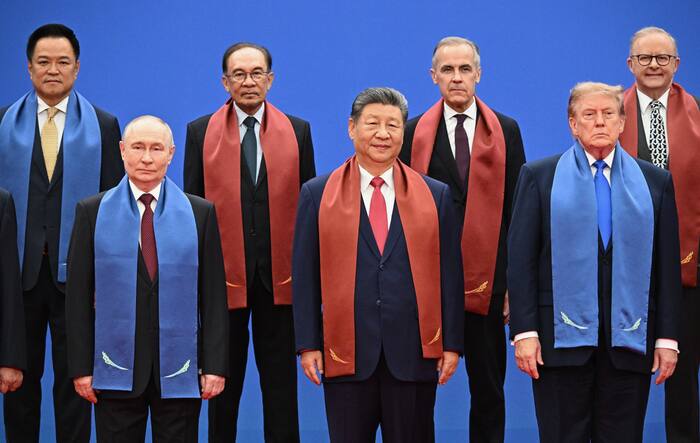
SHENZHEN – At the Asia-Pacific Economic Cooperation (APEC) summit on Thursday, Chinese President Xi Jinping emphasized the need for countries to come together to promote open trade and technological development. The summit, taking place in Shenzhen, a major technology hub in China, has highlighted the nation’s advancements in artificial intelligence among other innovations.
However, the event has been significantly impacted by major power dynamics as Xi prepares to engage in an unprecedented trilateral meeting with U.S. President Donald Trump and Russian President Vladimir Putin later in the day.
The annual APEC gathering has maintained its traditional format, featuring formal arrivals, a gala dinner, numerous bilateral meetings, and a group photo of leaders adorned in business attire with red or blue scarves. The venue’s modern ambiance has garnered extra attention due to the summit’s ongoing goals of establishing a free trade zone across the Pacific Rim amidst various geopolitical challenges.
During the closed-door leaders’ meeting, Xi urged the 21 APEC economies to unite in their shared interests. “APEC members are like passengers riding the same boat,” he said, highlighting the importance of collaboration to navigate challenges. He stressed the need to strengthen bonds and mutual interests among the members.
Putin, marking his return to an APEC summit for the first time in nine years, echoed Xi’s call for unity, suggesting that APEC should foster a constructive agenda for cooperation. On the other hand, Trump emphasized the strength of the U.S. economy, stating his administration has attracted trillions in investment and wealth, while also opposing global regulations on artificial intelligence.
Despite these discussions, tensions remain high, particularly regarding U.S. efforts to limit China’s access to advanced computer chip technology, which is critical for AI development. This issue has been further complicated by recent news involving Nvidia’s founder and a Chinese technology executive.
As the dialogue unfolds, Xi and other Asian leaders continue to advocate for equitable sharing and regulation of AI technology to ensure financial stability and growth. Earlier in the week, the United States announced tightened restrictions on remote access to advanced AI technologies, eliminating loopholes that previously allowed significant access to cutting-edge Nvidia chips.
Kristalina Georgieva, managing director of the International Monetary Fund, addressed the APEC leaders, noting that AI is having a significant impact on global growth. She reported that the APEC economies, which represent over half of global business activity, are growing at an annual rate of 3.4%, which outpaces the global growth rate of 3.1%. Furthermore, global trade growth has reached 4.6%, largely due to the ongoing investments in AI.
Georgieva underscored the urgency of adapting to AI advancements, stating, “This is the fastest transformation in human history. And to put it very simply, you snooze, you lose.”
