




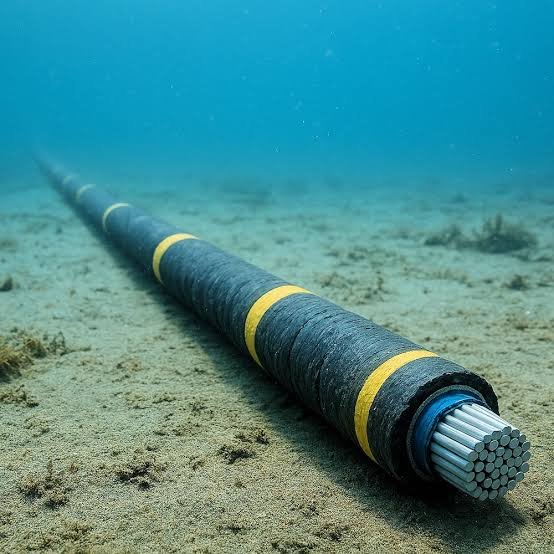
TeleGeography’s recent report reveals that global international bandwidth reached 2,259 terabits per second (Tbps) in mid-2026, marking a 23 percent increase year-on-year. Africa emerged as the fastest-growing region, with a compound annual growth rate of 35 percent from 2022 to 2026, outpacing other regions including Oceania, which saw 25 percent growth.
“Total international bandwidth now stands at an impressive 2,259 Tbps,” stated Paul Brodsky, senior research manager at TeleGeography. As of early 2025, there were 77 active or under-construction cable systems in Africa, with Egypt hosting 19 landings and South Africa 11. Notably, the 2Africa cable, backed by Meta, was activated in late 2025 and boasts a design capacity of 180 Tbps over 46 landing points across 33 countries. In addition, Google’s Equiano cable spans 15,000 kilometers and has a capacity of 144 Tbps.
However, figures regarding operational terrestrial fiber reveal a different story. Africa is estimated to have about 2.1 million kilometers of fiber, yet only approximately 1.3 million kilometers are fully operational. These statistics come from the Africa Broadband Outlook, a report by the African Telecommunications Union and Africa Analysis that covers data from 2024. The report indicated that around 58,000 kilometers of fiber became operational in the year leading up to June 2024.
Despite infrastructural developments, a significant gap remains in network functionality. Cable installations yield no revenue until they are activated and interconnected. A staggering 800,000 kilometers of constructed fiber in Africa is not fully active, underscoring the disparity between infrastructure and service delivery. Furthermore, only about 30 percent of Africans live within ten kilometers of a fiber node, and fixed-line subscriptions are minimal, with fewer than one in 100 individuals having access, compared to an average of 18 globally.
Shameel Joosub, CEO of Vodacom Group, emphasized during AfricaCom last year that the continent faces a critical shortage of fiber infrastructure. He argued for an integrated approach combining fiber, mobile, and satellite networks to maximize limited budgets.
While 92 percent of Africans live under mobile broadband coverage, only 36 percent utilize mobile internet, according to a GSMA report. This highlights a theoretical capacity that remains unrealized in practical usage, exacerbated by a lack of transparency in pricing data for inland network services, which complicates efforts to assess the efficacy of existing networks.
Landlocked countries suffer particularly, with only 25 percent of their populations using the internet in 2024, compared to a global average of 68 percent. Although 86 percent of this demographic is within range of mobile broadband signals, the disparity persists largely due to pricing structures imposed by neighboring countries’ terrestrial operators.
Despite ongoing challenges, progress is being made. For instance, in February 2026, Paratus activated a 2,000-kilometer fiber route connecting Mombasa to Goma, enabling direct access for the eastern Democratic Republic of Congo to regional subsea systems. Meanwhile, plans are underway for an East and Central African backbone capable of 38 Tbps.
High-speed infrastructure does yield positive results in connected areas. An impact assessment of the Equiano cable indicates an expected increase in average internet speeds in South Africa from 28 Mbps in 2021 to 75 Mbps by 2025, alongside a 21 percent decrease in retail prices.
Looking ahead, key indicators will determine the future of Africa’s fiber network. Monitoring the publication of updated terrestrial fiber surveys by the African Telecommunications Union, regulatory requirements for wholesale pricing transparency, and the impact of new routes on retail prices will be crucial for understanding the evolution of infrastructure across the continent.
