




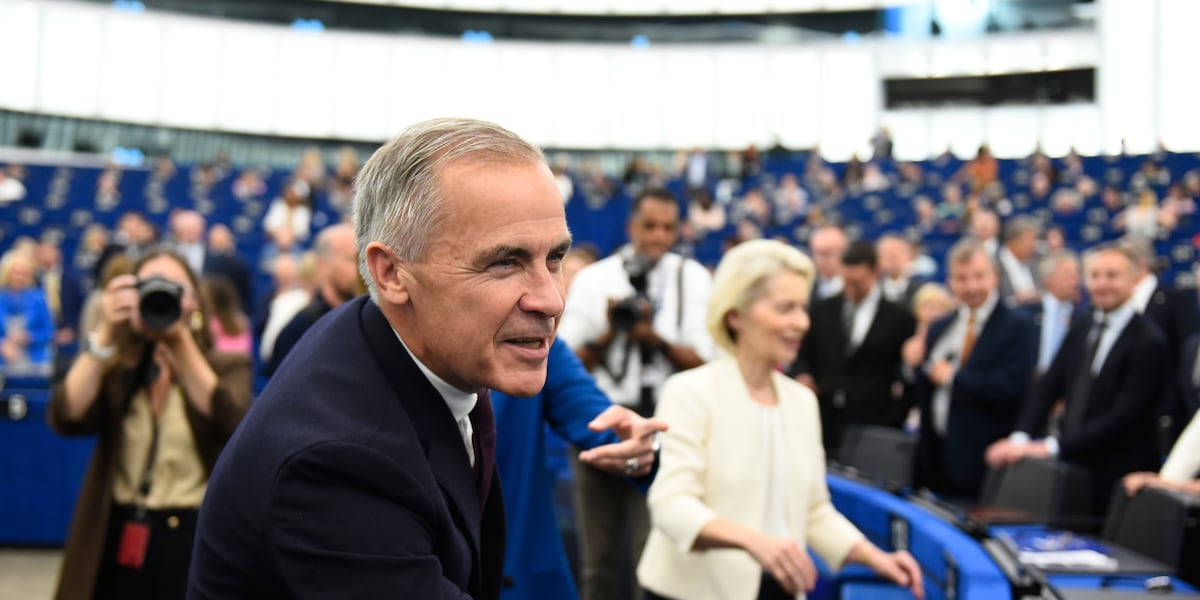
MONTREAL — Canadian Prime Minister Mark Carney announced on Friday that he anticipates finalizing negotiations with the European Union (EU) in June to establish Canada as the first “associate member” of the bloc. This initiative aims to strengthen ties and enhance sovereignty amid changing global dynamics.
The push for closer cooperation has gained momentum as U.S. President Donald Trump’s trade policies and confrontational stance towards traditional allies have prompted Canada and Europe to seek greater independence from Washington.
“What brings us together goes far beyond geography. We see the world through the same eyes,” said European Commission President Ursula von der Leyen. She emphasized that ongoing global challenges are a permanent shift, underscoring the need for a united front.
Carney noted that this new alliance would empower Canada and Europe to resist external economic pressures and make independent choices. In light of Trump’s comments suggesting that a Canadian EU partnership could be perceived as a “hostile act,” Carney refrained from directly addressing whether Trump might be welcomed into the alliance, maintaining that the initiative is not directed against any nation.
“It is about reinforcing sovereignty… so we can live our lives as we choose,” Carney stated. He emphasized that the alliance is intended to promote freedoms rather than serve as a countermeasure.
During a two-day summit in Montreal, Carney, von der Leyen, and European Council President António Costa launched the “Alliance for the Future,” highlighting progress in areas such as digital trade and investments in Canadian critical minerals and artificial intelligence.
Despite Carney and von der Leyen’s enthusiasm for the associate member designation, official documents from the summit referred instead to an “ever-closer association,” with plans to define this relationship by their next summit in 2027.
In preparation for the June meetings with EU leaders, Carney indicated that Canadian Cabinet ministers and European commissioners would convene in March. Costa confirmed that additional details would be announced at that time.
Von der Leyen asserted that there is substantial support for a closer relationship between Canada and the EU, despite varying opinions on the terminology used to describe it.
The discussions also included advancements in a free-trade agreement that eliminated most tariffs and a new digital trade agreement facilitating business operations across the Atlantic. Additionally, Canada is set to partner with the European Investment Bank to finance projects related to critical minerals, aiming to attract investments to its mining sector.
Furthermore, Canada will participate in a European supercomputing initiative, projecting significant advancements in research capabilities. Carney explained that this partnership would enhance connectivity between Canadian and European tech startups, leading to reduced regulatory hurdles and increased opportunities.
Looking ahead, the Alliance for the Future may extend outreach to other like-minded countries. Costa expressed a desire to create a unique relationship that surpasses any existing EU partnership with non-member states.
The leaders planned to explore the feasibility of exporting Canadian liquefied natural gas to Europe and enhancing undersea cable connections linking Canada, Europe, and Asia. They also aim to negotiate expanded Canadian involvement in the Erasmus+ student exchange program, facilitating better opportunities for youth education and work internationally.
Additionally, both sides committed to enhanced border security measures and collaboration on defense initiatives, cybersecurity, Arctic security, and addressing foreign interference. In the context of Canada’s economic strategy, Carney aims to double exports to countries outside the U.S., which accounted for 71.7% of Canada’s merchandise exports in 2025.
