




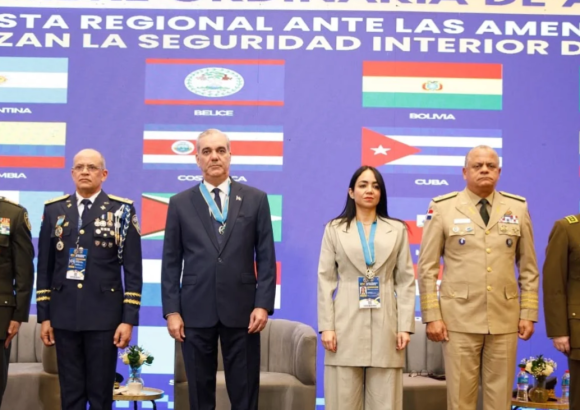
Santo Domingo – President Luis Abinader urged police authorities throughout the Americas to enhance international collaboration, share intelligence, and coordinate joint efforts to address transnational organized crime. His remarks came during the opening of the XVI Ordinary Summit of the Community of Police of the Americas (Ameripol) held in Santo Domingo.
Abinader emphasized that crime has progressed beyond a national concern, evolving into a regional and international challenge that necessitates coordinated responses. “Crime is not national, crime is regional, crime is international,” he stated, noting how criminal organizations exploit national borders to extend their activities.
The president underscored the significance of citizen security as fundamental for economic development and improved quality of life. He indicated that his administration has fortified security strategies through a weekly task force dedicated to assessing crime trends, coordinating actions, and monitoring outcomes. “A single homicide, a single robbery is one too many for our country,” he commented, acknowledging ongoing security challenges.
During his address, Abinader also highlighted the crucial role of international police meetings in exchanging best practices, experiences, and intelligence. He argued that strengthening institutional relationships and fostering trust are essential for effective cooperation against criminal threats.
At the summit, Ameripol honored Abinader with its Grand Extraordinary Order for his contributions to citizen security and international police cooperation. Major General Ernesto Rafael Rodríguez García, Director of the National Police, also received the Ameripol Order for his dedication to regional security.
Interior and Police Minister Faride Raful reiterated the Dominican Republic’s commitment to combating transnational crimes, including drug and arms trafficking, human trafficking, cybercrime, and money laundering. She also highlighted the ongoing reform of the National Police and the importance of ratifying the Brasilia Treaty, which would grant Ameripol its own legal status.
The summit brought together representatives from various international organizations, including Interpol, the Organization of American States, the United Nations Office on Drugs and Crime, and the European Anti-Fraud Office, alongside police and security officials from countries such as Spain, Portugal, Germany, France, Italy, Australia, and South Korea.
