




A research team at Sungkyunkwan University has developed a novel immunotherapy that combines electrical ablation with immune cell therapy to enhance treatment effectiveness against liver cancer. The study was led by Professor Wooram Park from the Department of Integrative Biotechnology, with Joo Dong Park and Ha Eun Shin serving as co-first authors.
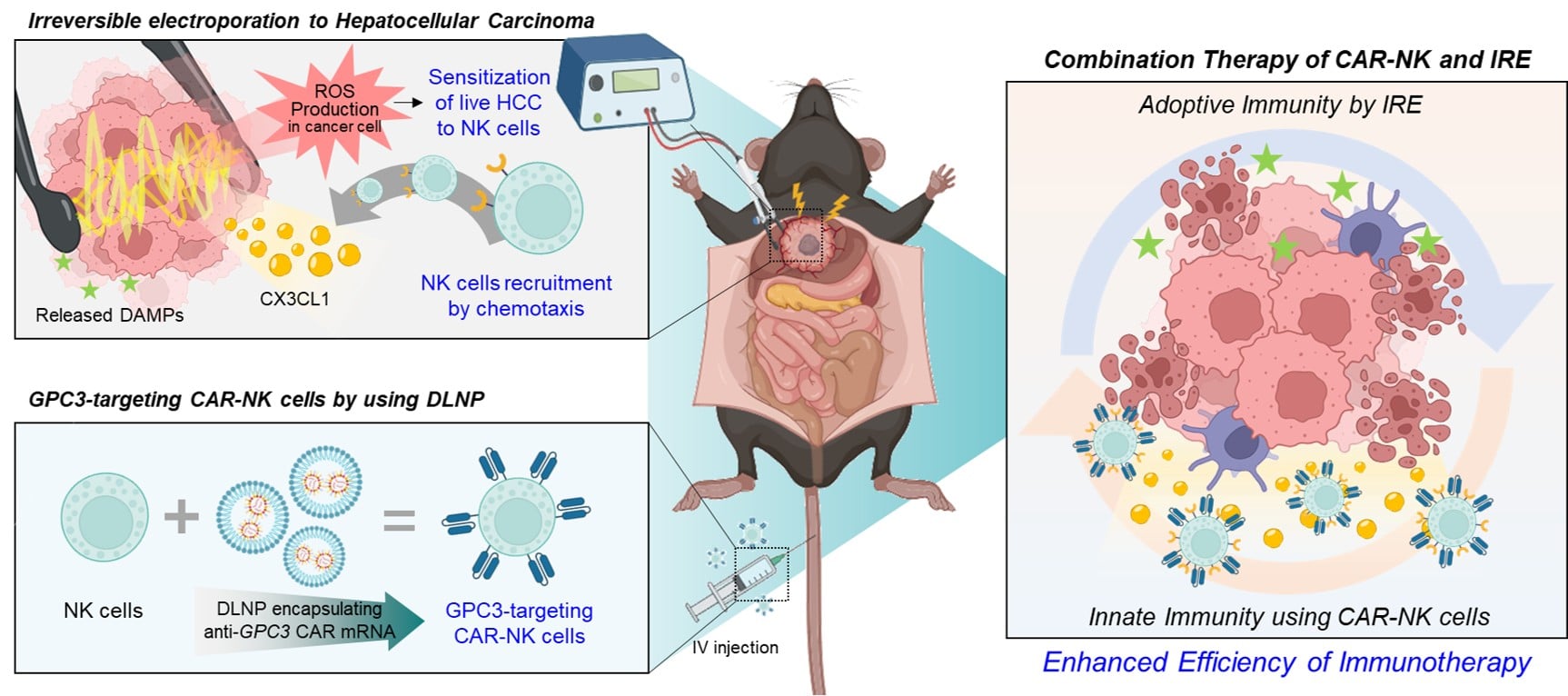
Conventional immune cell therapies often face challenges in penetrating liver tumors, especially hepatocellular carcinoma, which is characterized by a highly immunosuppressive tumor microenvironment. To address these limitations, the research team utilized irreversible electroporation (IRE), a clinically approved technique that employs high-voltage pulsed electric fields to destroy tumor cells.
This technique not only eliminates tumor cells but also prompts the release of damage-associated molecular patterns (DAMPs) and chemokines. These chemical signals attract immune cells, transforming the tumor environment into one conducive to natural killer (NK) cell activity, a key component of the immune response.
The researchers observed a significant increase in chemokine levels within tumors following IRE treatment, which facilitated the early recruitment of NK cells. They also discovered that increased levels of reactive oxygen species (ROS) generated by IRE heightened the vulnerability of remaining tumor cells to NK cell attacks.
Building on these findings, the team combined IRE with chimeric antigen receptor natural killer (CAR-NK) cells, which were engineered through lipid nanoparticle-based gene delivery technology. This combination therapy yielded notably better tumor control than either approach alone.
In laboratory tests, CAR-NK cells were able to quickly eliminate IRE-treated liver cancer cells. The combined therapy showed superior tumor suppression and extended survival across various preclinical models.
Professor Park emphasized the significance of this study, noting that it integrates established technologies—IRE, an LNP platform, and CAR-NK cells—to enhance the local tumor environment and facilitate precision cellular immunotherapy. He expressed optimism that this approach could swiftly transition into clinical practice as a combination therapy.
The results of the study were published online in March 2026 in Signal Transduction and Targeted Therapy, a leading international journal in biochemistry and molecular biology.
