




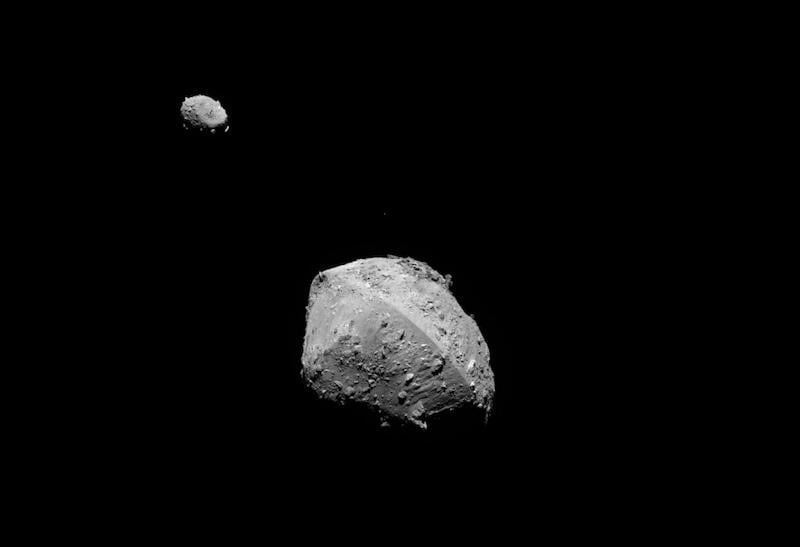
The European Space Agency (ESA) has unveiled the first images from its Hera mission, revealing that the Dimorphos asteroid, struck by a NASA spacecraft four years ago, features a significant crater and has experienced changes to its orbital characteristics. These findings confirm the effectiveness of NASA’s Double Asteroid Redirection Test (DART) mission, which aimed to test technology for deflecting potentially hazardous asteroids.
The images illustrate that one side of Dimorphos has been flattened, resulting in a crater the size of a stadium. The successful impact from the DART mission altered the asteroid’s orbit, demonstrating that kinetic impact could be a viable planetary defense method against asteroids that threaten Earth.
ESA’s Hera mission, which is currently in progress, aims to study Dimorphos in greater detail. It is part of a broader effort to understand the characteristics of asteroids and how they can be affected by human actions. The data gathered from Hera will provide critical insights into the future of planetary defense strategies.
As part of the mission, ESA scientists will analyze the crater and other surface features to learn more about the composition and structure of Dimorphos. The investigation will expand our understanding of these celestial bodies and their potential risks to Earth.
The Hera spacecraft is expected to reach Dimorphos in the coming years, allowing scientists to gather more extensive data. According to ESA officials, this collaboration with NASA marks a significant step forward in the field of planetary science and defense.
