




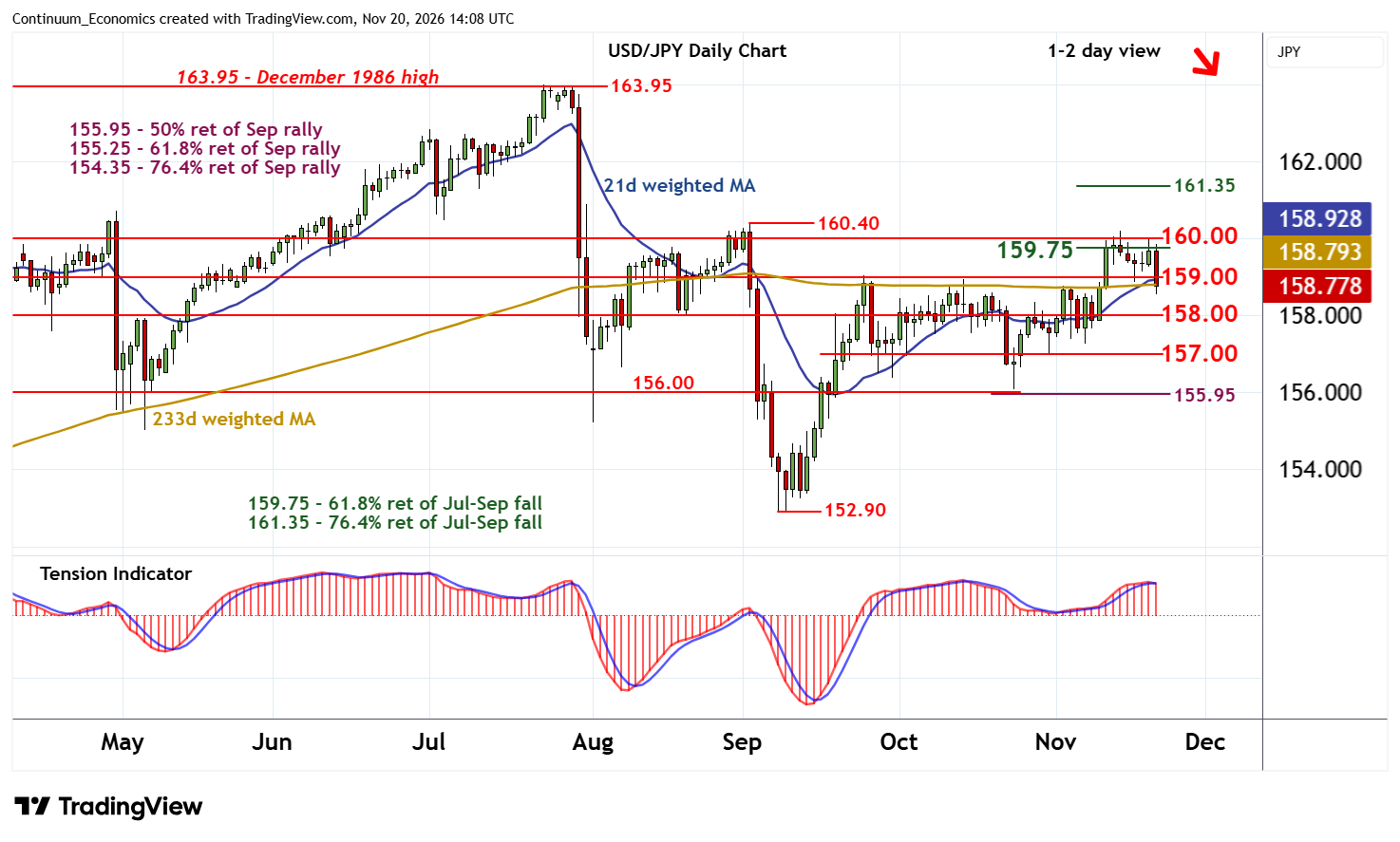
The Japanese yen is being viewed as a favorable risk hedge amid recent market volatility, with traders advised to closely monitor the shifting factors that could influence the dollar’s performance. Analysts are noting that the current landscape reflects significant changes, particularly in the context of a tech and AI sector correction and ongoing pressure in Asian and Chinese markets.
Despite a flashy initial public offering (IPO) from Anthropic, which drew brief attention, the broader market has experienced considerable losses, marking the most substantial decline since the COVID-19 pandemic. This raises questions about the potential for further negative trends. The market remains in the challenging November period, though the Thanksgiving holiday might provide a pause for traders to reassess their positions and strategies.
Market dynamics have shifted significantly, especially with the recent interest rate increases putting downward pressure on the yen. As noted in intraday reports, traders may benefit from the yen’s sell-off as a potential hedge. Currently, the USD/JPY pair shows signs of downwards consolidation, hovering around the 158 to 160 range.
In recent weeks, the dollar’s ascent has been buoyed by a combination of factors, including market adjustments to Federal Reserve pricing and shifting inflation scenarios. However, there are indications that this upward momentum may be stalling, with analysts observing a lack of further traction in the dollar as market conditions continue to evolve.
As the technology sector correction unfolds, several factors could contribute to a reevaluation of market positions. Commodity prices have decreased, and recent U.S. economic data has started to reflect a potential slowing trend. Such developments may point to a pivot in market sentiment, suggesting that some previous drivers of dollar strength may not hold indefinitely.
Turning to the Australian dollar, positioning remains heavily skewed with record short positions, and the AUD/USD pair is approaching significant support levels between 0.6660 and 0.6625, indicating possible opportunities for traders.
Upcoming Economic Data
In the United States, markets will receive critical economic indicators throughout the week, including the S&P PMIs for November on Monday, followed by consumer confidence figures on Tuesday. On Wednesday, October’s core PCE prices are anticipated to rise by 0.3%, similar to the core Consumer Price Index (CPI), while overall PCE prices are expected to increase by 0.3%. Additionally, Q3 GDP figures may be revised up to 3.6% from the previous 3.4% estimate.
Notably, the Thanksgiving holiday will pause the data releases on Thursday, with initial jobless claims rescheduled for Wednesday. On Friday, the advance goods trade deficit for October is projected to worsen, climbing to $143.3 billion from $135.1 billion.
In Canada, the calendar remains relatively quiet, with the Q3 current account figures set for release on Friday. The UK and Eurozone are both anticipating November PMIs, with the UK showing signs of stable service sector activity. Lastly, in Japan, the Tokyo Consumer Price Index will be closely watched as analysts expect it to accelerate to 3%, indicating ongoing inflationary pressures as the country enters a holiday week.
