




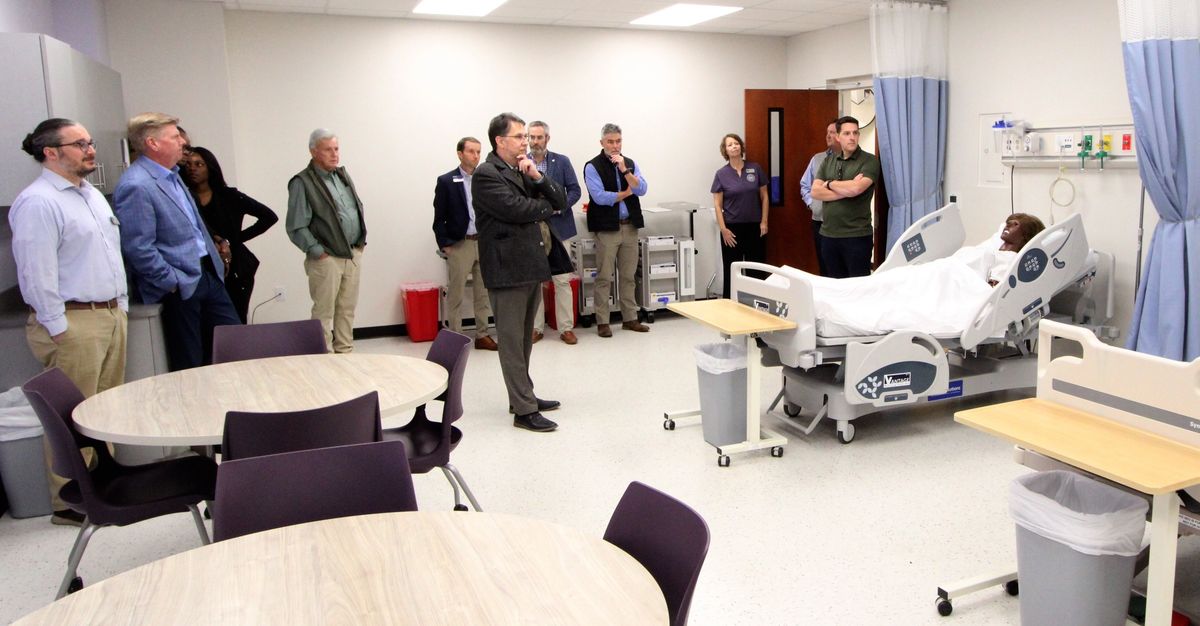
Wilson Community College has recently completed renovations to its health sciences lab and learning space, funded by a $3 million federal grant from the Health Resources and Services Administration. This investment aims to enhance training for students and meet the growing healthcare needs of the community.
On November 19, approximately 50 community members toured the newly upgraded facilities located on the ground floor of Building G on the college’s main campus. Jami Woods, the college president, emphasized the importance of these renovations, stating that they would provide a modern learning environment for future healthcare workers.
“First Congressional District Congressman G.K. Butterfield was instrumental in helping us secure [the grant] before he left office,” Woods noted. She added, “We need facilities that are commensurate with what they are going to see when they are actually out doing their job, and we feel like this renovation is going to allow them to have a totally different caliber of education.”
Miranda Yelverton, dean of health sciences, reported that the college currently has between 200 and 300 students enrolled in health sciences programs. The renovations were designed to expand simulation spaces, reflecting the growth of these programs and the community’s needs. “We are increasing our seats in our nursing program, specifically the practical nursing program effective fall of 2027,” Yelverton said.
The revamped facility now includes additional hospital beds, patient care areas, and specialized environments such as an ICU room equipped with a high-fidelity AI simulator. Other features include an ambulance simulator and an immersive room that allows students to engage in realistic scenarios. For the first time, the college has implemented a simulated operating room for its surgical technology program.
“The surgical tech room is really amazing,” Woods remarked, highlighting how it closely simulates a real operating environment. “We have got an ICU unit and lots of opportunities for faculty to observe while students are in these spaces.” The college also introduced a central sterile processing short-term training program.
Yelverton stressed the necessity for the college’s programs to expand in response to Wilson’s growth. “We are also looking to the future to expand the health science programs that we are offering here at Wilson,” she said. The renovations are intended to align the training facilities with evidence-based practices and improve student learning outcomes.
