




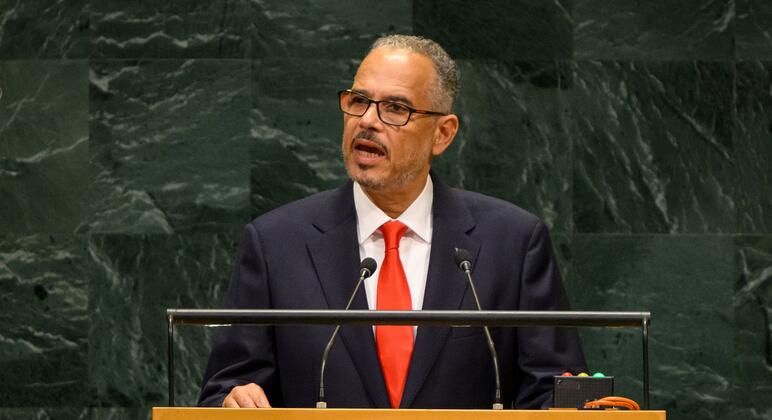
Prime Minister Ariel Henry of Haiti addressed world leaders at a United Nations meeting, emphasizing that the country is facing a critical turning point amid escalating criminal violence. Mr. Henry described the situation as threatening communities nationwide but asserted that Haiti remains resolute in shaping its own future.
“Haiti will resist. Haiti is standing tall,” he stated, urging the international community to support Haiti in its efforts rather than attempting to determine its path. He called for collaboration that respects Haiti’s autonomy during this turbulent period.
Call for Action and Support
The Prime Minister highlighted the urgent need for decisive international action due to the extreme levels of violence, including massacres and attacks against vulnerable populations, particularly women and children. He honored both victims of violence and security personnel who have lost their lives in the line of duty, asserting that their experiences should not be reduced to mere statistics.
In response to the crisis, the Haitian government is working to enhance its security forces, including a program aimed at training 4,000 police officers, of which over 2,000 have already completed training. Additionally, more than 1,500 soldiers have finished their training, with plans to develop another 15,000 soldiers over the next three years. The Prime Minister emphasized that their mission extends beyond immediate crisis response; it aims to cultivate sustainable security capabilities in Haiti.
Mr. Henry expressed concern regarding the international security force designed to assist Haiti, which has not yet reached its intended strength of 5,500 personnel. He urged for the renewal and full deployment of the “gang suppression force,” emphasizing that mere mandates without operational forces and adequate resources do not suffice.
The Prime Minister also called for intensified international efforts to combat arms trafficking, pinpointing the role of transnational criminal groups in supplying weapons that contribute to violence in Haiti. In a bid to address impunity, the government has initiated two specialized judicial hubs that focus on financial and mass crimes as well as sexual violence, and has reactivated its national commission for disarmament, demobilization, and reintegration.
On the topics of elections and economic recovery, Mr. Henry stated that restoring security must be accompanied by democratic governance through “free, credible, inclusive and honest elections.” Enrollment centers have opened, and political actors are engaged in the electoral process. He emphasized the need for a transformative approach in Haiti’s economic relations with international partners, advocating for a shift from foreign aid to investment.
“We need to move from aid to investment, from assistance to production, from dependency to partnership,” he noted, highlighting that job creation, particularly for the youth and women, is crucial for fostering lasting peace.
Despite the extensive challenges facing Haiti, Mr. Henry concluded with an encouraging message of determination. “The challenges are colossal, but our willpower is even greater,” he asserted, stressing the importance of allowing the “tree of liberty” to flourish with peace.
Why It Matters
This moment in Haiti’s history is significant not only for national stability but also for the regional security landscape. The Prime Minister’s appeal for increased international support and proactive measures could influence the potential for recovery and democratic governance in a nation grappling with severe socio-economic difficulties.
