




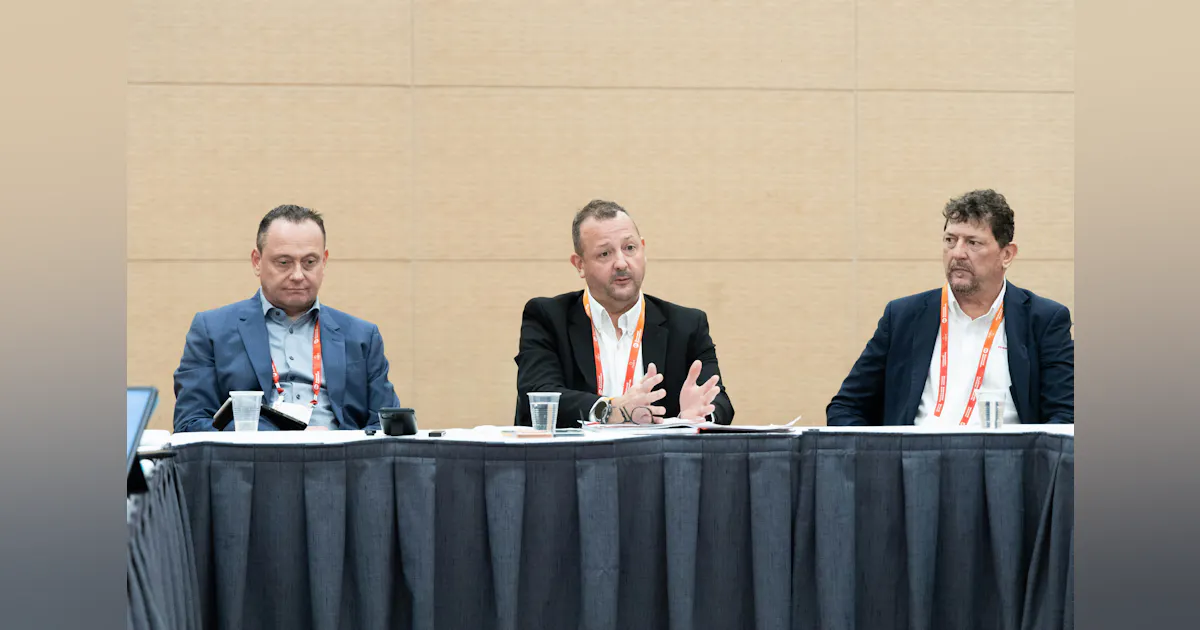
Bradman Lake, a packaging machinery manufacturer based in the U.K., is advancing packaging technology through the use of independent cart technology (ICT), enabling machines to adapt to the movement of individual products rather than relying on traditional mechanisms. This innovation allows for greater flexibility in handling various products and configurations within a smaller production footprint.
The company demonstrated its integrated packaging line at Automation Fair 2026, highlighting a collaboration with Rockwell Automation. This system features flow wrapping and cartoning functionalities, utilizing Rockwell’s iTRAK independent cart technology, which incorporates servo motion and integrated machine controls.
According to John Marlee, managing director of Bradman Lake, the partnership with Rockwell has developed over three decades alongside advancements in industrial automation. Steven Rackham, the company’s group technical manager, explained that ICT introduces a pivotal shift in the design of packaging machinery. Each mover operates with independent motion control, allowing products to be adjusted in speed, spacing, and direction, similar to how each carriage of a train can operate independently.
Rockwell’s iTRAK system replaces traditional rotary-driven transport systems with software-controlled motion profiles, accommodating straights and curves in track configurations. Rackham emphasized the transformative potential of this technology, stating that it enables manufacturers to rethink how products are presented at processing stations. “Whereas before we had to get the product synchronized to the machine, now with ICT we can bring the machine to the product,” he noted.
Factory space is a crucial consideration for food manufacturers needing to accommodate increased product varieties without expanding their facilities. Conventional packaging lines often require extensive infeed equipment to ensure products are correctly oriented and timed before reaching the wrapping stage. However, with ICT, products can be introduced at irregular intervals, allowing for optimal alignment with the packaging machinery.
Marlee stated that integrating iTRAK with a flow wrapper can significantly reduce the amount of traditional infeed equipment needed. For example, a flow-wrapping system that previously required about 10 meters in length could be reduced to approximately five meters. This shrinkage results in fewer mechanical components, potentially lowering energy consumption as well.
The flexibility offered by ICT is increasingly valuable as manufacturers move toward smaller production runs and diverse packaging formats. Marlee cited a cereal manufacturer’s need to shift from producing standard 12-count packages to various configurations, highlighting that previously necessary extensive mechanical adjustments could now be streamlined using independent motion technology.
Bradman Lake’s advances also extend to custom applications, such as a project with a U.K. customer producing personalized testing kits for the National Health Service (NHS). This system was designed to process different kit configurations daily, demonstrating the system’s adaptability without relying on a fixed production run.
As ICT alters established design practices, Marlee indicated that Bradman Lake utilizes modular machine architecture, allowing engineers to adapt designs based on customer specifications for floor space and throughput. This modularity complements ICT by permitting coherent operations along the same track.
While the introduction of ICT reduces the complexity of mechanical transport, it still necessitates maintenance for components like bearings and guide rails. Marlee noted that recent enhancements at Rockwell have allowed for a more unified software environment, integrating machine motion with other control functions.
The integration of advanced technologies, including CompactLogix controllers and ArmorKinetix servo technology, enables monitoring of individual movers, helping identify maintenance needs proactively. It reflects Bradman Lake’s commitment to innovating in areas like packaging materials, making changes feasible to accommodate sustainable options like recyclable films and paper.
The developments from Bradman Lake and Rockwell Automation signify a shift toward more versatile and efficient packaging systems, focusing not only on immediate operational needs but also on the broader challenges of sustainability and production adaptability.
